

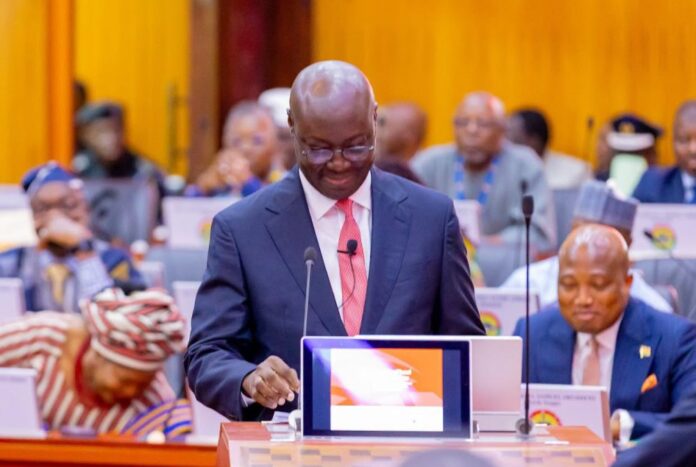

The government has deposited US$1.7 billion into a dedicated account at the Bank of Ghana for the construction of the Accra-Kumasi Expressway, Finance Minister Dr Cassiel Ato Forson has announced.
According to the Finance Minister, the funds have been ring-fenced exclusively for the transformational road project and will only be accessed after the main construction contract has been awarded.
Dr Ato Forson announced on Thursday, July 23, 2026, during his presentation of the 2026 Mid-Year Budget Review to Parliament.
Also read: ‘Economic recovery not good luck’ – Ato Forson touts superior management
The Accra-Kumasi Expressway is the flagship project under the government’s Big Push infrastructure programme and is expected to connect Ghana’s two largest commercial cities through a 176-kilometre, six-lane bi-directional expressway.
When completed, the project is expected to reduce travel time between Accra and Kumasi to approximately two hours.
US$1.7bn secured
Dr Ato Forson said the government had made substantial progress towards preparing the Accra-Kumasi Expressway project for construction.
He disclosed that, as of July 22, 2026, the government had deposited US$1.7 billion into a dedicated account at the Bank of Ghana solely for the project.
The Finance Minister said the money had been ring-fenced and would be used only after the main construction contract had been awarded.
“Government is therefore confident that all the requirements for this transformational project, including the resources, the money, will be in place when His Excellency President John Dramani Mahama cuts the sword for the construction of the project to begin,” Dr Ato Forson told Parliament.
Procurement for the main construction contract, he said, is expected to commence in September 2026.
The Finance Minister said the Ghana Armed Forces had cleared approximately 122 kilometres of the project’s right-of-way, representing about 70% of the corridor.
The clearance, he said, was achieved within 12 weeks.
The entire corridor is expected to be cleared by the first week of September 2026, while compensation assessments, environmental studies, engineering designs and feasibility works are progressing simultaneously.
Dr Ato Forson said the feasibility study and detailed engineering design are expected to be completed by the end of August 2026.
The government is subsequently expected to move forward with procurement for the main construction contract.
The completed expressway is expected to improve road safety, ease congestion, reduce transportation costs and introduce modern infrastructure, including interchanges, bridges, intelligent transport systems, electronic tolling, emergency response facilities and rest areas.
Big Push in all 16 regions
The Accra-Kumasi Expressway forms part of a broader infrastructure drive under the government’s Big Push programme.
Dr Ato Forson said the programme is currently driving one of the largest coordinated investments in strategic transport infrastructure in recent years, with projects underway in all 16 regions.
According to him, work has commenced on 87 projects, comprising 74 trunk roads and bridges, 10 urban roads and three other major road projects.
By the end of June 2026, 13 projects had reached at least 50% completion, including six projects that had exceeded 75% completion.
A further 15 projects had progressed beyond 25% completion.
The Finance Minister said significant progress had been recorded on several key corridors, including the Kasoa-Winneba, Takoradi-Agona Junction, Ofankor-Samreboi, Tema-Aflao, Penyi-Aflao, Wenchi-Sunyani, Atimpoku-Ho-Aflao, Tumu-Hamile, Tumu-Navrongo and Winneba-Cape Coast-Takoradi roads.
He also said work is progressing on the Suame Interchange Phase 2 and the Sunyani, Tamale and Kumasi Outer Ring Roads.
Road projects in the Eastern and Volta regions, he added, were also improving access to farming communities and markets.
Dr Ato Forson said government would, during the second half of 2026, fast-track projects nearing completion. He said measures would also be introduced to improve contractor performance and remove bottlenecks that could delay the completion of major road projects.
The move is intended to ensure that ongoing infrastructure investments deliver tangible benefits to communities and the wider economy within the expected timelines.
The Finance Minister also announced progress on the Adawso–Ekye Amanfrom Bridge, a 3.6-kilometre permanent bridge expected to become the longest bridge in Ghana when completed.
The bridge is intended to replace the ferries currently used by residents of the Afram Plains area to cross the Afram River.
Dr Ato Forson said the frequent delays and seasonal disruptions associated with ferry transportation had affected the movement of people, agricultural produce and essential services.
The new bridge is expected to connect the Afram Plains area to Ghana’s national road network and unlock the agricultural potential of one of the country’s key food-producing zones.
The project is expected to make it easier for farmers to transport maize, cassava, yam, rice and other agricultural produce to markets.
It is also expected to improve access to healthcare and education while creating jobs, attracting investment and supporting food security. The bridge is targeted for completion by the end of 2028.
The Minister indicated that the government is also advancing work on the Dambai Bridge, which is expected to provide a permanent crossing between Dambai and Dodi Kope and strengthen transportation along the Eastern Corridor.
The project comprises a 1.49-kilometre bridge and approximately 6.8 kilometres of approach roads.
As of the end of June 2026, physical progress on the project stood at 6%, slightly ahead of schedule. Foundation works and construction of a temporary bridge are already underway.
US$528m agriculture enclave roads
Dr Ato Forson disclosed that government is investing US$528 million in the rehabilitation of 1,050 kilometres of feeder roads across four major agricultural production corridors under the Agriculture Enclave Road Programme,
The programme is expected to improve connectivity between farms and markets, reduce post-harvest losses and lower transportation costs.
It is also projected to create approximately 25,000 direct and indirect jobs, including at least 7,500 jobs for women. The government expects the programme to reduce travel time by more than 40% on paved roads and 30% on unpaved roads.
The first phase will cover four agricultural clusters across 13 regions.
Agriculture Enclave Road Clusters
- Cluster 1: 300km across the Upper West, Northern and Savannah regions.
- Cluster 2: 300km across the Oti, Volta and Eastern regions.
- Cluster 3: 250km across the Ashanti, Bono East and Eastern regions.
- Cluster 4: 200km across the Western North, Western and Ahafo regions.