

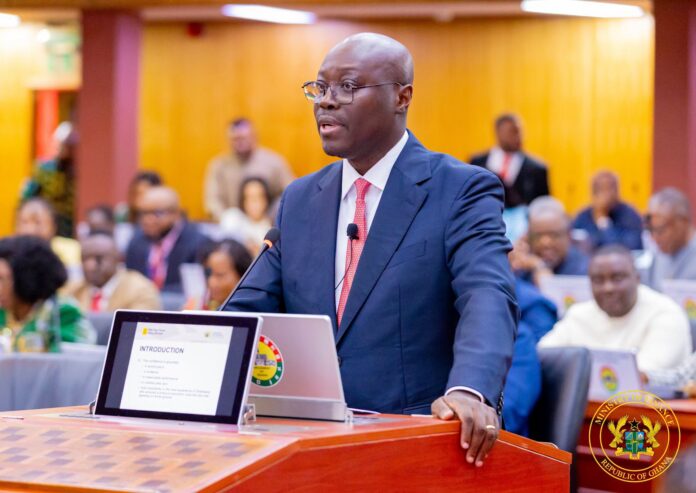

Finance Minister Dr Cassiel Ato Forson has attributed Ghana’s economic recovery to what he described as superior economic management, insisting that the country’s turnaround from economic crisis to renewed stability is not the result of good fortune.
Dr Ato Forson made the declaration on Thursday while presenting the 2026 Mid-Year Budget Review to Parliament, where he outlined the government’s economic reforms and fiscal measures aimed at restoring macroeconomic stability and strengthening Ghana’s public finances.
The Finance Minister also rejected suggestions that Ghana’s economic recovery was driven solely by the country’s debt restructuring programme or the IMF-supported economic framework.
Also read: Oppong Nkrumah challenges govt’s debt analysis, demands broader assessment of sustainability
“I firmly disagree. Ghana’s recovery is as a result of superior economic management,” Dr Ato Forson declared.
His comments form a central part of the government’s defence of its economic record as it seeks to demonstrate that the improvements recorded in Ghana’s economy are the result of deliberate policy choices, fiscal reforms and disciplined economic management.
Economic crisis to recovery
Dr Ato Forson pointed out that Ghana’s economic crisis in 2022 was the product of policy failures, including excessive spending, high borrowing and inadequate fiscal discipline.
According to the Finance Minister, the crisis resulted in severe economic consequences, including significant depreciation of the Ghana cedi, high inflation, declining purchasing power and a loss of investor confidence.
The difficult economic conditions, he said, also contributed to significant pressure on households and businesses, while the country’s debt restructuring programme affected bondholders and other investors.
Dr Ato Forson said the experience should serve as a lasting lesson for policymakers and strengthen Ghana’s commitment to protecting macroeconomic stability.
“Some lessons cannot simply be taught. They must be lived. But once learned, they must never be forgotten. Never again, Mr Speaker,” he said.
The Finance Minister’s remarks underline the government’s position that the current Ghana economic recovery must be protected through stronger fiscal management and responsible economic policymaking.
Pillars driving economic recovery
Dr Ato Forson identified three major areas as central to the government’s economic transformation agenda.
These include fiscal correction, modernisation of Ghana’s tax regime and complementary fiscal policies aimed at supporting inflation targeting and exchange-rate stability.
The Finance Minister said the measures had contributed to a significant improvement in Ghana’s fiscal position.
According to the figures presented, primary expenditure declined from 18.7% of GDP in 2024 to 13.2% of GDP in 2025, representing a 5.5 percentage-point adjustment within a single year.
The primary balance also shifted from a deficit of 2.9% of GDP in 2024 to a surplus of 2.5% of GDP in 2025.
The government has subsequently moved to institutionalise fiscal discipline through amendments to the Public Financial Management Act.
The amended framework establishes a fiscal rule requiring a minimum annual primary surplus of 1.5% of GDP and sets a debt-to-GDP ceiling of 45% by 2034.
Beyond the headline fiscal figures, Dr Ato Forson highlighted several institutional reforms introduced to improve public financial management and strengthen accountability.
These include the establishment of a Value for Money Office to improve expenditure efficiency and a Fiscal Council to enhance oversight, transparency and fiscal accountability.
The government has also undertaken an audit of its payables, while amendments to the Public Procurement Act now require commitment authorisation before procurement activities are undertaken.
According to Dr Ato Forson, the reforms are designed to prevent the accumulation of irregular financial obligations and ensure that government spending remains aligned with available resources.
The Finance Minister said the measures have also helped strengthen confidence among investors and development partners.
The Finance Minister also pointed to the country’s progress under its IMF-supported economic programme.
The latest IMF review of Ghana’s economic reforms has provided further support for the government’s fiscal consolidation efforts, with the programme’s progress linked to improvements in key economic indicators.
Dr Ato Forson said the positive assessment from the IMF reinforces the government’s position that the economic recovery is the result of superior management policies.