

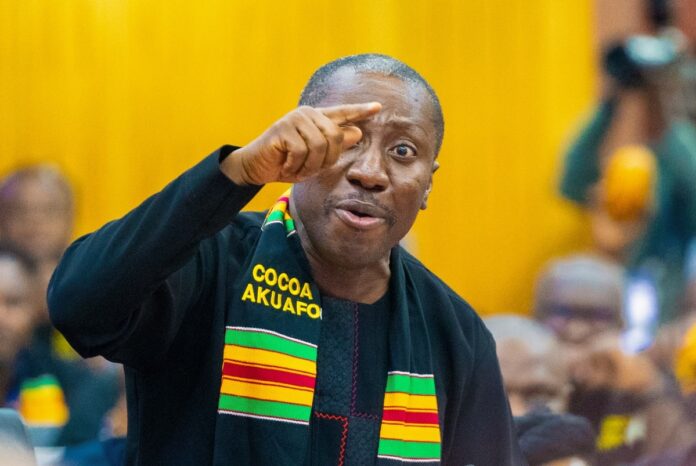

Minority Leader Alexander Afenyo-Markin has challenged the Ghana Gold Board (GoldBod) over its response to reported losses under the Domestic Gold Purchase Programme (DGPP), insisting that key financial questions remain unanswered.
Mr Afenyo-Markin said GoldBod Chief Executive Officer Sammy Gyamfi’s response at the Government Accountability Series on Wednesday did not dispute the reported US$1.7 billion (GH¢22 billion) loss associated with the programme in 2025, but rather sought to distance GoldBod from responsibility for the financial loss.
“The loss is admitted,” Mr Afenyo-Markin said in a statement on Wednesday.
Also read: ‘I will go to prison in his brain’ – Sammy Gyamfi fires back at Afenyo-Markin over bail conditions
He argued that regardless of which government institution ultimately carries the loss on its balance sheet, the financial impact remains a burden on the Republic and must therefore be properly accounted for.
GoldBod’s GH¢907m surplus
The Minority Leader also questioned GoldBod’s explanation of the fees it earned from the Domestic Gold Purchase Programme and its reported operational surplus.
According to Mr Afenyo-Markin, Mr Gyamfi disclosed that GoldBod accounted for approximately GH¢133 billion in advances during 2025 and received an assay fee of 0.258 per cent as well as a service fee of 0.5 per cent.
Based on those figures, the Minority Leader estimated that GoldBod earned approximately GH¢1 billion in fees from the programme.
He questioned why GoldBod’s reported GH¢907 million operational surplus should be presented as evidence of strong financial performance without factoring in the fees generated from a programme that allegedly resulted in a GH¢22 billion loss to the state.
“The plain implication of his own numbers is that the operational surplus he is celebrating is smaller than the fee income he collected from a programme that lost the state 22 billion Ghana Cedis,” he said. “Strip out the agency fees, and there is no operational surplus to speak of.”
GoldBod cannot claim benefits and reject costs
Mr Afenyo-Markin accused GoldBod of taking credit for the broader economic gains associated with the Domestic Gold Purchase Programme while distancing itself from the financial consequences.
He referenced GoldBod’s claims that the scaling-up of the DGPP contributed to the 41 per cent appreciation of the Ghana cedi, helped increase Ghana’s international reserves from US$8.9 billion to US$13 billion, and supported the decline in inflation.
“An institution that claims authorship of the benefits cannot describe itself as a passive agent when the costs are counted,” he argued.
The Minority Leader said the government and GoldBod must therefore provide a clear account of how the reported loss arose and who ultimately bears the financial responsibility.
Mr Afenyo-Markin also raised concerns about what he described as changing arrangements for financing the Gold-for-Reserves Programme (GANRAP).
He said the GoldBod CEO indicated that responsibility for financing GANRAP moved from the Bank of Ghana to the Ministry of Finance in July 2026, before GoldBod began seeking independent funding from August.
The Minority Leader described the changes as evidence that the financing structure for the programme remains unsettled.
“Three funding arrangements in six months is not a settled model. We view this with curious eyes,” he said.
The GH¢22bn loss must be accounted for
Mr Afenyo-Markin maintained that the GH¢22 billion loss reported in connection with the Domestic Gold Purchase Programme must be treated as a financial loss to the Republic and fully accounted for.
He referred to the figure as being contained in the IMF’s Sixth Country Report and called for greater transparency over the finances of the programme.
“The 22 billion Ghana Cedis losses as reported by the IMF Sixth Country Report, numbered 26/213 issued in August 2026, amount to a financial loss to the Republic. It must be accounted for!” he declared.
The Minority Leader also criticised comments attributed to Mr Gyamfi during the GoldBod CEO’s response, particularly a reference to a brothel.
He described the language as inappropriate for a public officer responding to questions about the management of public funds.
“Ghanaians asked for figures. They were given insults. The figures are still outstanding,” Mr Afenyo-Markin stated.
The latest exchange adds to the growing political debate over GoldBod’s financial performance, the Domestic Gold Purchase Programme, the reported GH¢22 billion loss, and the management of Ghana’s gold-for-reserves initiatives.