

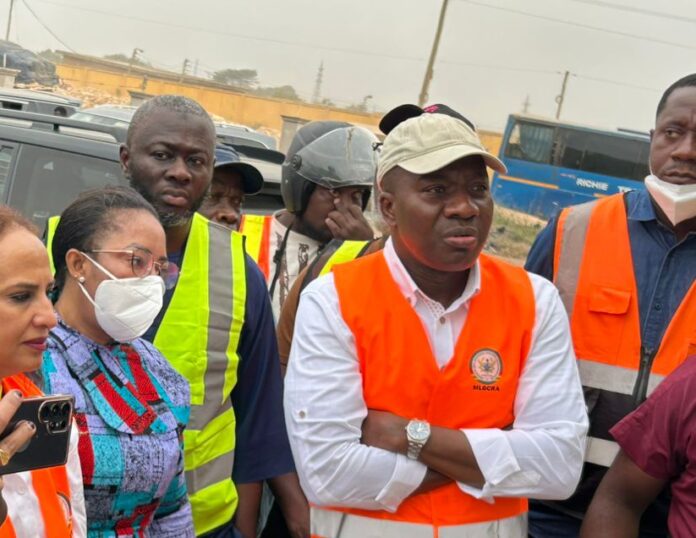

Minister for Local Government, Chieftaincy and Religious Affairs, Mahama Ayariga, has vowed to take tough and unpopular decisions to clean up and address Accra’s persistent sanitation and waste management challenges.
He said his priority would not be to win popularity but to enforce the rules and ensure that residents, businesses and institutions take responsibility for keeping the capital clean.
“My tenure as Minister for Local Government is not going to be an easy one. I’m not engaging in a popularity contest. I don’t want to be popular,” he said. “If I get popular, I want to be popular for making sure that everybody is uncomfortable doing the wrong things.”
Also read: ‘If you live in Accra, pay for your waste’ – Ayariga takes a hard line
The Minister made the remarks on Tuesday, September 1, 2026, during a tour of waste management facilities in Accra.
He described the sanitation situation in the capital as a serious but solvable problem, stressing that effective collaboration among local authorities, government agencies, residents and businesses could reverse the situation.
“I am 100% convinced that even though it’s a serious problem, it is not an insurmountable problem,” Mr Ayariga said.
‘Polluter must pay’
A major part of the Minister’s proposed approach is the strict enforcement of the “polluter pays” principle.
Mr Ayariga argued that factories, businesses, households and other establishments operating in Accra must contribute adequately towards the cost of managing the waste they generate.
He said the assemblies would have greater capacity to deal with the sanitation crisis if they could collect all the statutory rates due to them.
According to him, factories and other structures operating in Accra contribute significantly to the generation of waste and must therefore bear part of the cost of managing it.
“If you follow the polluter pays principle, you are the person causing the waste. You are the one to pay for the waste,” he said.
Mr Ayariga also questioned the practice of relying on the national Common Fund to address sanitation challenges in Accra.
“The waste should not be paid for from the Common Fund. Common Fund is to be distributed to the rest of the country,” he said.
He urged people who live and operate businesses in Accra to pay for the services they consume in the city.
“If you are living in Accra, pay for your waste in Accra,” he stressed.
Assemblies must also account
While demanding greater compliance from residents and businesses, Mr Ayariga acknowledged that local authorities must improve their systems for collecting rates.
He said assemblies must make it easier for residents and businesses to pay what they owe.
“It is improper and bad management for the assembly not to make it easy for you to pay. So you must make it easy for people to pay,” he said.
He added that assemblies would also be required to account for the revenue collected.
According to the Minister, residents who pay their rates must see tangible improvements in their communities, including better waste management, street lighting, roads, green spaces, security and access to basic amenities.
He therefore challenged residents to demand accountability from local authorities if the revenues collected are not used to improve their communities.
‘War against indiscipline’
Mr Ayariga announced plans for a broader campaign against poor sanitation practices and indiscipline.
He said the campaign would require the active involvement of the media because some of the measures to be introduced could face resistance from sections of the public.
The Minister said the media would have an important role in explaining the rationale behind the enforcement measures and helping the public understand why compliance was necessary.
“When we start doing the right things, those who are uncomfortable will start complaining. And we need you to explain to them why the right things must be done,” he said.
He also asked the media to hold the government and local authorities accountable if they fail to use collected resources to improve sanitation and other basic services.
Mr Ayariga said the government could no longer afford to delay action on Accra’s sanitation problems.
These, he said, are things that should have been done yesterday but unfortunately, they are being done today.