

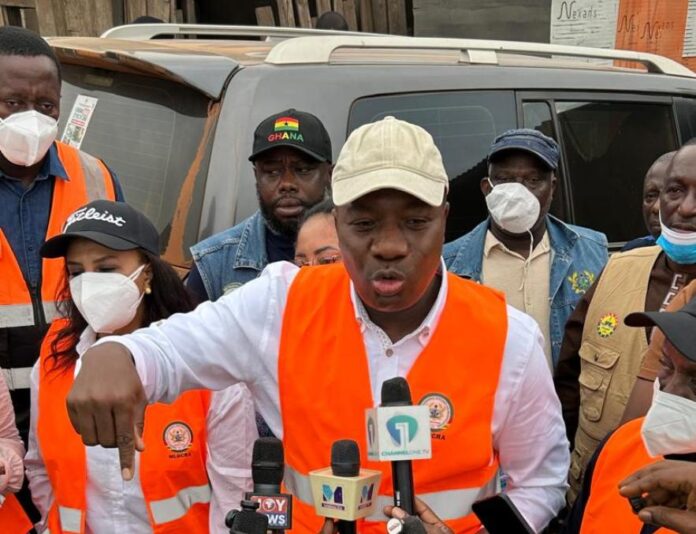

New Minister for Local Government, Chieftaincy and Religious Affairs, Mahama Ayariga, has called for strict enforcement of the payment of statutory rates by households, businesses and factories in Accra to help address the city’s persistent waste management challenges.
According to him, the Accra waste crisis can be tackled if city authorities can collect all the rates that residents, businesses and other establishments are required to pay.
“If we collect the market rate, if we collect all the rates that everybody is supposed to pay to the city authorities, I am very confident that problems like this will not be beyond our capacity,” he said.
Also read: Front Pages: Top newspaper headlines for Tuesday, 1st September 2026
Mr Ayariga made the remarks on Tuesday, September 1, 2026, during a tour of waste management facilities in Accra.
He argued that factories, businesses and other establishments operating in the capital must bear greater responsibility for the waste they generate, in line with the “polluter pays” principle.
According to him, sanitation should not become an excessive burden on the national Common Fund, stressing that residents and businesses operating in Accra must contribute adequately towards maintaining the city.
“The waste should not be paid for from the Common Fund. Common Fund is to be distributed to the rest of the country,” he said.
Mr Ayariga also noted that industrial activity and government institutions in Accra contribute to the rapid growth of the city’s population and, consequently, the volume of waste generated.
Businesses, industries, government and households, he said, must therefore share responsibility for solving the sanitation challenge, with development partners providing additional support.
‘War against indiscipline’
Mr Ayariga announced plans for a campaign to improve sanitation and tackle what he described as indiscipline among residents.
“We are going to launch a campaign. A campaign against sanitation that is not properly managed. A war against indiscipline because part of the problem is indiscipline,” he said.
He identified failure to pay statutory rates as one aspect of the problem, but acknowledged that local authorities must also improve the systems through which residents pay.
“It is indiscipline not to pay the rates that you are supposed to pay to your assembly. It is indiscipline,” he said. “Even though I also agree that it is improper and bad management for the assembly not to make it easy for you to pay. So you must make it easy for people to pay.”
The Minister, however, warned that assemblies would also be held accountable for how collected revenues are used.
He said residents who pay their rates must see improvements in basic services, including waste management, street lighting, roads, greenery, security and access to basic amenities.
Not a popularity contest
Mr Ayariga cautioned that efforts to enforce sanitation rules and revenue collection could attract resistance, but said he is prepared to take difficult decisions.
“My tenure as Minister for Local Government is not going to be an easy one. I’m not engaging in a popularity contest. I don’t want to be popular,” he said. “If I get popular, I want to be popular for making sure that everybody is uncomfortable doing the wrong things.”
He called for support from the media, particularly when the government begins enforcing sanitation and revenue-collection measures.
Mr Ayariga urged the media to also hold government and local authorities accountable if revenues collected from residents and businesses are not used to improve communities.
“We demand that you also hold us accountable for not doing the right thing,” he said.
Despite describing Accra’s sanitation situation as a serious problem, the Minister expressed confidence that it could be resolved through coordinated action.
“I am 100% convinced that even though it’s a serious problem, it is not an insurmountable problem if we work together with the Mayors, the MMDCEs, the Ministry and all the other agencies that are supposed to coordinate with our ministry to get these problems fixed,” he said.
He said his ministry is ready to begin work immediately, stressing that several of the measures needed to address the problem should have been implemented earlier.