

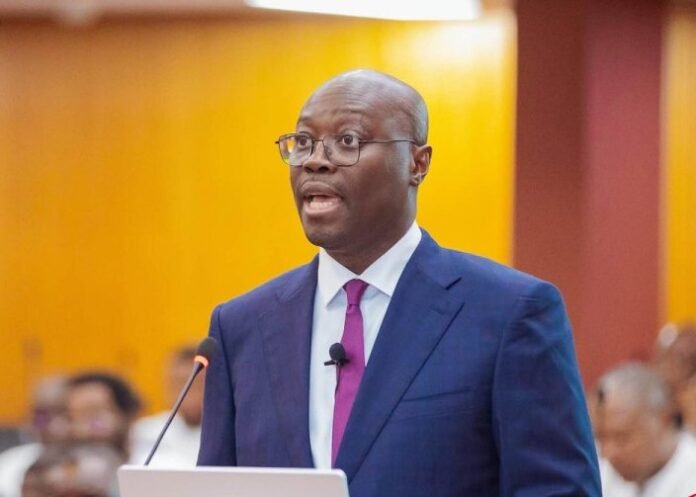

Finance Minister Dr Cassiel Ato Forson has cautioned that Ghana cannot achieve sustainable economic prosperity through excessive borrowing.
According to him, the country’s economic transformation must rather be driven by responsible investment, increased production and sustainable growth.
The Finance Minister made the call at the 2027 post-budget workshop on Monday, in a speech read on his behalf by his deputy, Thomas Ampem Nyarko.
Also read: Bagbin tasks MPs to defend public interest through 2027 Budget scrutiny
He assured that the government is determined to balance fiscal discipline with the need to invest in productive sectors of the economy.
Dr Ato Forson stressed that although Ghana has made progress in restoring macroeconomic stability, the next phase of the country’s economic recovery must focus on expanding production, creating jobs and improving living standards.
“Our guiding principle is that we cannot borrow our way to prosperity; neither can we cut our way to transformation. We must invest responsibly, produce competitively, and grow sustainably,” he told lawmakers.
He explained that the 2027 budget is designed to move the country beyond macroeconomic stabilisation towards an economy capable of producing more of what it consumes, processing more of what it produces and exporting products with greater value addition.
He acknowledged that Ghana remains exposed to commodity price volatility, liabilities in the energy sector and debt-service obligations, making prudent fiscal management essential to sustaining the country’s economic recovery.
As part of measures to manage future debt obligations, the Finance Minister said the government is building both Cedi and dollar sinking fund accounts, while strengthening debt management and maintaining fiscal buffers to protect the country’s public finances.
“We cannot build tomorrow’s prosperity by recreating yesterday’s debt crisis,” he emphasised.
He also defended the government’s decision to reduce the primary surplus target from 1.5 per cent to 0.5 per cent of Gross Domestic Product (GDP) in 2027.
Dr Ato Forson said the adjustment is deliberate and intended to create fiscal space for productive investment without compromising fiscal and debt sustainability.
He, however, cautioned that the lower surplus target should not be interpreted as permission for uncontrolled expenditure.
According to him, government would strengthen commitment controls, prevent the accumulation of new arrears, improve procurement discipline and ensure that public investments deliver measurable economic value.
The 2027 budget projects total revenue and grants of approximately GH¢323.1 billion, against expenditure of GH¢375 billion on a commitment basis. The overall fiscal deficit is projected at 2.9 per cent of GDP, while the primary surplus is expected to stand at 0.5 per cent.
The Minister disclosed that the government intends to mobilise the cedi equivalent of US$10 billion between 2027 and 2030 under its New Economy programme.
For 2027, an allocation of GH¢30 billion has been provided to support productive investment in commercial agriculture, industrial development, energy, value addition and other strategic sectors.
He said the investment programme would complement the Big Push infrastructure initiative and other growth-enhancing interventions aimed at addressing structural constraints that have limited Ghana’s productive capacity.
The Finance Ministry maintained that public investment must be assessed against its contribution to production, employment and economic value.
He stated that every major investment must answer three fundamental questions: what it would produce, how many jobs it would support and what measurable economic value it would deliver.
He outlined the government’s broader economic targets for 2027, including real GDP growth of at least 5.2 per cent, non-oil GDP growth of 5.7 per cent, inflation within a target band of 8 per cent plus or minus 2 per cent, and gross international reserves equivalent to at least six months of import cover.
He noted that the economy has expanded by 6.2 per cent in the first half of 2026, while inflation stood at 5.5 per cent in October. Gross international reserves had also reached US$12.1 billion, equivalent to 4.5 months of import cover, at the end of September.
Dr Ato Forson welcomed Parliament’s scrutiny of the budget, describing it as a contract with the Ghanaian people that must be examined, properly financed and subjected to accountability.
The Finance Ministry, he said, remains committed to providing timely fiscal information, engaging parliamentary committees and strengthening transparency in the implementation of the budget.
He urged lawmakers to focus their scrutiny on revenue projections, expenditure allocations, financing arrangements and the management of fiscal risks to ensure that the government’s economic commitments translate into tangible improvements in the lives of Ghanaians.