

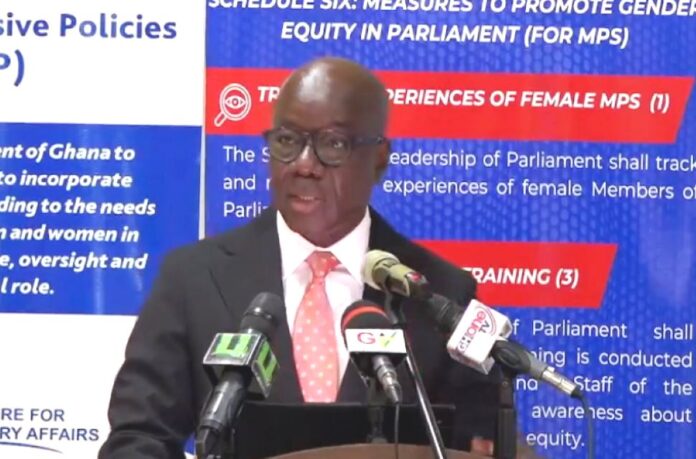

The African Centre for Parliamentary Affairs (ACEPA) has warned Parliament against losing the gains made in gender-responsive governance following the conclusion of a four-year project aimed at promoting inclusive legislative processes and gender equality.
ACEPA Executive Director Rasheed Draman said the long-term success of the Inclusive Legislatures for Gender-Responsive Policies (ILGRP) project would depend on Parliament’s ability to integrate its achievements into institutional systems and everyday parliamentary practices.
Speaking at the project’s closing workshop at Parliament House in Accra on Thursday, October 29, 2026, Mr. Draman cautioned that reforms could be lost if they remain dependent on temporary funding, individual champions or project-supported activities.
Also read: Bagbin pledges to strengthen gender-responsive governance in Parliament
“What is not institutionalized is at risk of being lost,” he said, urging parliamentary leadership, Members of Parliament and the Parliamentary Service to make gender responsiveness an integral part of the institution’s operations.
The ILGRP project has sought to strengthen Parliament’s capacity to promote inclusive governance, improve gender-responsive legislation and budgeting, and ensure public policies reflect the different needs and experiences of women and men.
Rasheed Draman stressed that gender equality in parliamentary governance goes beyond increasing the number of women occupying parliamentary seats. It also requires institutions to consider whose voices influence decisions, which issues receive attention and how public resources are allocated.
“When Parliament considers legislation, scrutinizes public expenditure, oversees government programmes and represents citizens, it must ask a fundamental question: Who benefits from this decision, who might be left behind, and what can we do about it?” he said.
He argued that these considerations should become part of routine parliamentary business rather than remain temporary project objectives.
According to him, institutional planning, human resource management, budgeting, parliamentary procedures and oversight are critical areas where the lessons from the project must be sustained.
Draman also challenged Parliament to measure the project’s success through tangible improvements in its operations rather than the number of workshops conducted, policies discussed or participants trained.
“The responsibility now is to ensure that the lessons of ILGRP become part of how Parliament plans its work, manages its resources and evaluates its performance,” he said.
He emphasised that sustaining the gains would require collective ownership across Parliament, rather than reliance on a single department, committee or group of committed individuals.
Although the formal phase of the ILGRP project has ended, Draman reaffirmed ACEPA’s commitment to supporting stronger, more inclusive and accountable legislatures across Africa.
He expressed appreciation to Global Affairs Canada, Parliament’s leadership, the Parliamentary Service and other partners for contributing to the initiative.
Draman urged stakeholders to protect and deepen the progress achieved, stressing that the responsibility to build inclusive institutions does not end when a development project closes.
He said the ultimate legacy of the initiative should be a Parliament that works more effectively, inclusively and equitably for all Ghanaians.
-
ACEPA Challenges Parliament to Protect Major Gender Equality Gains
-
ACEPA Pushes Bold Reforms to Secure Gender-Responsive Governance in Ghana
-
Rasheed Draman Urges Parliament to Turn Gender Equality Gains Into Lasting Reforms
-
ACEPA Sets Powerful Agenda to Strengthen Gender Equality in Parliament
-
Parliament Urged to Build Lasting Legacy From Gender Equality Project