

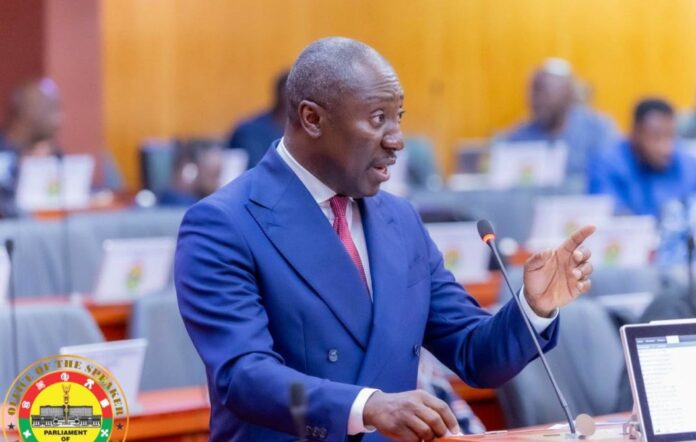

Minority Leader in Parliament, Alexander Afenyo-Markin, has urged President John Dramani Mahama to withhold assent to the controversial Tribunals Bill, warning that the legislation could push the state back to the era of the ‘kangaroo courts.’
Mr Afenyo-Markin made the call during his closing remarks at the end of Parliament’s sitting on Friday, July 31, 2026, arguing that the Tribunals Bill will undermine Ghana’s justice system and revive memories of politically abused tribunals, despite constitutional provisions allowing for the establishment of tribunals.
The Minority Leader said the debate over the Tribunal Bill must be considered in the context of Ghana’s constitutional history and previous experiences with public tribunals.
Also read: NPP to stage nationwide protest over Sedina acquittal
According to Alexander Afenyo-Markin, Articles 125, 142 and 143 of the 1992 Constitution provide for public and regional tribunals.
However, he said recent constitutional reform recommendations point in a different direction, with the Constitutional Review Committee recommending the removal of the tribunal system and its replacement with ordinary courts.
Mr Afenyo-Markin said the Constitutional Review Committee, established by President Mahama and chaired by constitutional scholar Professor H. Kwasi Prempeh, submitted its report to the President in December 2025.
He said the committee recommended that Ghana’s existing tribunal system should be expunged and replaced with the ordinary court system.
“The President’s own reviewers told him to close this door. Instead, his side in Parliament forced it open,” the Minority Leader stated.
“We, the Minority, stood up. We walked out. So history would have no doubt where we stood,” Mr Afenyo-Markin added.
‘kangaroo courts’
The Minority Leader argued that the Tribunal Bill could revive painful memories of Ghana’s Public Tribunals and Community Tribunals established in the 1980s.
Those tribunals, he said, were widely criticised over alleged human rights abuses and concerns about due process and judicial independence.
Mr Afenyo-Markin said the tribunals eventually became associated with the description “kangaroo courts”, reflecting concerns over the fairness of proceedings and the protection of individual rights.
Alexander Afenyo-Markin also raised concerns about provisions of the Tribunals Bill that could allow people without formal legal training to serve as members of tribunal panels.
While acknowledging that the bill requires tribunal members to possess high moral character, he argued that moral integrity alone may not be sufficient to determine complex legal cases.
He said tribunal members could potentially preside over cases involving fraud, tax offences and mining-related crimes, despite not having formal legal education.
The Minority Leader also questioned the legal immunity granted to tribunal members while performing their official duties.
He described the combination of extensive judicial powers, limited legal training and immunity as a potentially dangerous arrangement.
“If Court of Appeal judges sometimes overturn decisions of High Court judges over errors in applying the law, what happens when people without legal training are asked to decide similar cases?” he questioned.
Reject Tribunals Bill
Mr Afenyo-Markin appealed directly to President Mahama to decline assent to the Tribunal Bill and return it to Parliament for further consideration.
He urged the President to listen to the recommendations of the Constitutional Review Committee rather than proceed with legislation that, in his view, could have serious consequences for Ghana’s justice system.
“Kangaroo courts built to be used against your opponents today can be turned on you tomorrow. Nobody wins that game. Only the law loses,” Mr Afenyo-Markin warned.
The Minority Leader disclosed that the NPP Minority Caucus is studying the government’s position paper on proposed constitutional reforms following the Prempeh Committee’s work.
He said the New Patriotic Party (NPP) would consult internally and engage its national party structures before issuing a comprehensive response to the government’s proposed constitutional amendments.