

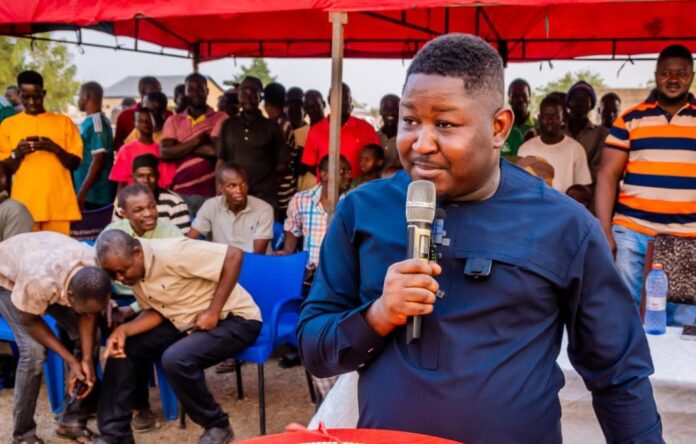

Member of Parliament for Sagnarigu, Atta Issah, has defended the performance of the government, arguing that improving inflation, falling interest rates and stronger investor confidence show that Ghana’s economy is on the path to recovery.
According to him, Ghana’s relatively stable inflation, which he placed within the 8 to 10 per cent range, is helping to create a more predictable economic environment for households and businesses.
Speaking during the parliamentary debate on the 2026 Mid-Year Budget Review on Tuesday, Mr Issah said the true performance of a national budget should ultimately be measured by its impact on the livelihoods of citizens and the wider economy.
Also read: Patrick Boamah challenges Ato Forson over procurement reforms in mid-year budget review
According to the Sagnarigu MP, the decline in interest rates is another indication of improving economic conditions.
He noted that bank lending rates had fallen from about 32 per cent to 15.6 per cent, while the Ghana Reference Rate had declined from approximately 29 per cent to 10.06 per cent. He also cited a reduction in the policy rate from about 29 per cent to 14 per cent.
Mr Issah argued that the decline in interest rates is creating easier and cheaper access to capital for businesses and the private sector.
“That guarantees easy and cheaper sources of capital for the private sector,” he said.
He added that access to private capital had consequently increased by 2.8 per cent.
The Sagnarigu MP also highlighted what he described as significant improvements in Ghana’s external sector and international economic standing.
According to him, Ghana is no longer being described as a “junk economy” and has regained the confidence of international rating agencies.
According to him, rating agencies around the world have assessed Ghana’s economic outlook as stable with positive prospects.
Mr Issah argued that these developments demonstrated the progress made under the current government’s economic management and provided evidence that the country’s recovery was gaining momentum.
The MP challenged claims by the Minority that the government is failing to generate sufficient revenue and execute its expenditure programme.
He presented comparative fiscal performance figures covering the period from 2017 to 2026 and argued that the NPP’s revenue performance during its first three years in office was weaker than the current government’s performance in 2025.
According to figures cited by Mr Issah, the NPP budgeted to raise GH¢44.96 billion in 2017 but realised GH¢41.25 billion, resulting in a shortfall of GH¢3.71 billion.
In 2018, he said, the government projected revenue of GH¢49.40 billion but realised GH¢46.81 billion, while in 2019 it targeted GH¢58.91 billion and collected GH¢54.56 billion.
By comparison, Mr Issah said the government in 2025 projected revenue of GH¢229.95 billion and realised GH¢226.49 billion, representing a shortfall of GH¢3.46 billion.
He therefore questioned the basis for the Minority’s criticism of the government’s revenue performance.
Mr Issah also rejected claims that the government is failing to execute its budget.
He compared expenditure execution under the NPP between 2017 and 2019 with the performance recorded in 2025. According to him, expenditure execution stood at 94.5 per cent in 2017, 95.7 per cent in 2018 and 96.5 per cent in 2019. In 2025, he said, expenditure execution reached 94.4 per cent.
The Sagnarigu MP argued that the figures did not support the claim that the government is failing to spend its approved budget.
“There is no better way of measuring whether a budget is performing or not. This is the scorecard on budget execution,” he said.
Mr Issah stressed that the strongest evidence of the current government’s economic performance is reflected in price stability, falling interest rates and improving investor confidence.