

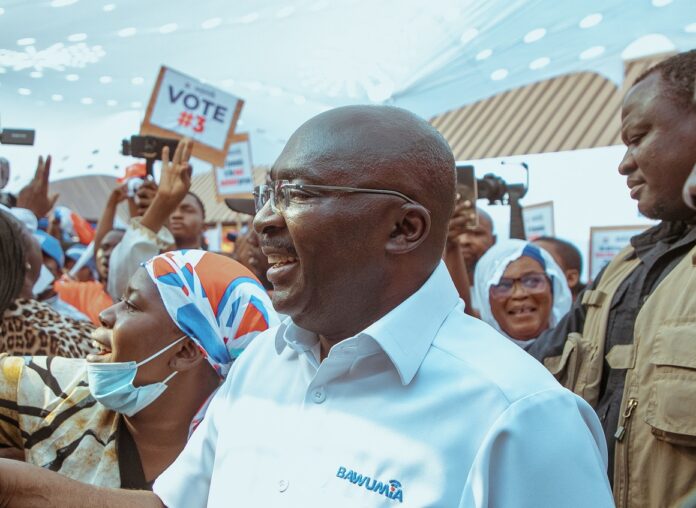

Former Vice President and 2028 New Patriotic Party (NPP) flagbearer, Dr Mahamudu Bawumia, has explained the rationale behind Ghana’s Domestic Gold Purchase Programme (DGPP) and the Gold-for-Oil (G4O) initiative, saying both policies were introduced as emergency measures to address severe foreign exchange shortages.
Dr Bawumia said the Domestic Gold Purchase Programme and Gold-for-Oil were conceived during an economic crisis triggered by the COVID-19 pandemic and the Russia-Ukraine war, when Ghana faced significant balance-of-payments pressures and limited access to international capital markets.
According to him, the two initiatives were designed to create alternative mechanisms for meeting Ghana’s critical import needs while reducing pressure on scarce US dollars.
He made the remarks on Thursday, August 27, 2026, when he engaged the Ghana National Association of Small-Scale Miners as part of consultations on reforms to address challenges in the mining sector.
Also read: NPP elections 2026: 47 aspirants file nominations as 3 drop out
Dr Bawumia said Ghana had traditionally depended heavily on international capital markets to raise foreign currency to finance economic activities.
However, he said access to that source of financing became severely constrained following the global economic disruptions caused by the COVID-19 pandemic and the Russia-Ukraine conflict.
“You know, before then we would normally go to the capital markets, raise $3 billion and then go on in terms of our economic management,” he said.
“But suddenly that gap was shut for quite a few countries. And for us it resulted in a balance of payments crisis,” he added.
He said the situation was further complicated by Ghana’s engagement with the International Monetary Fund (IMF), under which the Bank of Ghana faced restrictions on the amount of foreign exchange it could use to intervene in the foreign exchange market.
According to Dr Bawumia, the central bank’s intervention ceiling was about $80 million per month, which he considered inadequate compared with Ghana’s monthly foreign exchange demand.
“And you can imagine what the demand for foreign exchange for Ghana would be every month, significantly more than $80 million a month,” he said.
Dr Bawumia explained that the imbalance between foreign exchange demand and supply intensified pressure on the cedi.
“So in that particular framework that we were in, there was only one result, was when demand exceeds supply, prices would go up, isn’t it?” he said.
He said the cedi subsequently came under sustained pressure and depreciated rapidly as Ghana struggled to secure enough foreign exchange to support normal economic activity.
“We were really constricted in terms of availability of foreign exchange. And at the same time the cedi was depreciating almost daily,” he said.
Against this background, Dr Bawumia said policymakers had to explore alternative ways of using Ghana’s natural resources to support the economy and meet critical import requirements.
The former Vice President said the severe foreign exchange challenges contributed to the decision to introduce the Gold-for-Oil programme.
He explained that the initiative was designed to use Ghana’s gold resources as a means of settling payments for petroleum products, thereby reducing the need to use scarce US dollars for oil imports.
“And so why don’t we come up with the idea of gold for oil to start with, to exchange our gold for oil so that we get out of this foreign exchange construct,” he said.
Dr Bawumia described the Gold-for-Oil programme as an emergency response to the foreign exchange constraints confronting Ghana at the time.
“And this is the background of the gold for oil program which essentially saved us from a bigger crisis,” he said.
He argued that the arrangement helped Ghana avoid potentially serious fuel supply challenges at a time when access to foreign exchange was severely restricted.
“Because if we had not been able to pay for the oil, then we would have had major fuel shortages and so on,” he added.
Dr Bawumia said the Gold-for-Oil initiative also underscored the importance of securing sufficient quantities of gold to support such arrangements.
“So that was a measure that was introduced. Of course we had to buy the gold, isn’t it?” he said.
He explained that this contributed to increased attention to domestic gold purchase and the broader use of Ghana’s gold resources as part of efforts to address the country’s foreign exchange challenges.
According to Dr Bawumia, Ghana’s position as one of Africa’s largest gold producers made the mineral an important strategic resource during periods of economic difficulty.
He recalled that the idea of making greater use of Ghana’s gold resources occurred to him while exercising.
“When you look at Ghana, we are Africa’s number one gold producer,” he said.
He added that Ghana ranked among the world’s leading gold producers, placing the country around fifth globally.
For Dr Bawumia, Ghana’s significant gold production presented an opportunity to develop alternative mechanisms for supporting the economy and reducing dependence on conventional foreign exchange sources during periods of severe financial pressure.
The former Vice President said the Domestic Gold Purchase Programme and Gold-for-Oil initiative should therefore be understood within the context of the economic and foreign exchange pressures Ghana faced at the time.