


China has expressed its readiness to support Ghana’s New Economy Programme through strategic cooperation in artificial intelligence (AI), green technology, industrial upgrading, green agriculture, mining, and other emerging sectors.
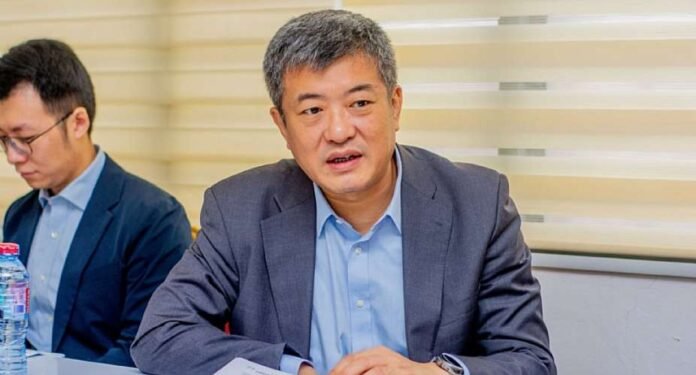
Cong Song, the Chinese Ambassador to Ghana, said the two countries had significant opportunities to deepen collaboration in emerging technologies and high-growth industries, accelerating Ghana’s industrialisation and economic transformation.
He said China was prepared to share its development experience, transfer appropriate technologies and collaborate with Ghana in building local capacity, developing technical expertise and strengthening its innovation ecosystem.
Also read: Workers need better conditions, not GH¢720m presidential jet – Abu Jinapor slam gov’t
Song made the remarks at a press briefing in Accra on Monday to discuss the outcomes of the Fifth Plenary Session of the 20th Central Committee of the Communist Party of China (CPC), held in Beijing from October 26 to 29.
Responding to questions on China’s potential support for Ghana’s New Economy Programme, he said the two countries could align China’s 15th Five-Year Plan with Ghana’s 24-Hour+ Economy and Reset Ghana Agenda to identify areas of mutual interest and accelerate development.
He identified artificial intelligence, green technology, industrial upgrading, green agriculture and sustainable mining as key areas with considerable potential for bilateral cooperation.
The New Economy Programme, announced by Finance Minister Dr Cassiel Ato Forson during the presentation of the 2027 Budget Statement to Parliament, is a US$10 billion economic transformation initiative scheduled to run from 2027 to 2030.
The programme represents an average investment of US$2.5 billion annually over the four years.
For 2027, the Government has earmarked GH¢30 billion, equivalent to 1.5 per cent of Gross Domestic Product (GDP), for its implementation.
The programme is anchored on eight pillars: commercial agriculture; energy infrastructure; critical minerals value addition; tourism and creative arts; textiles and garments; pharmaceuticals and biomanufacturing; technology; and macroeconomic stability and affordable finance.
It seeks to expand domestic production, promote value addition, create employment and position the private sector as a major driver of economic growth.
Mr Song noted that Ghana had already launched its National Artificial Intelligence Strategy and was advancing the One Million Coders Programme, providing opportunities for cooperation in talent development, technology transfer and innovation.
“There is considerable potential for cooperation between China and Ghana in areas such as talent training, smart healthcare and many other areas,” he said.
He said China’s experience in industrial transformation, scientific advancement and technological development could provide valuable lessons for Ghana as it sought to expand its productive capacity and accelerate economic modernisation.
Citing China’s progress in artificial intelligence, electric vehicles and other emerging industries, he said sustained investment in research, innovation and technology had been central to the country’s industrial development.
CNR