

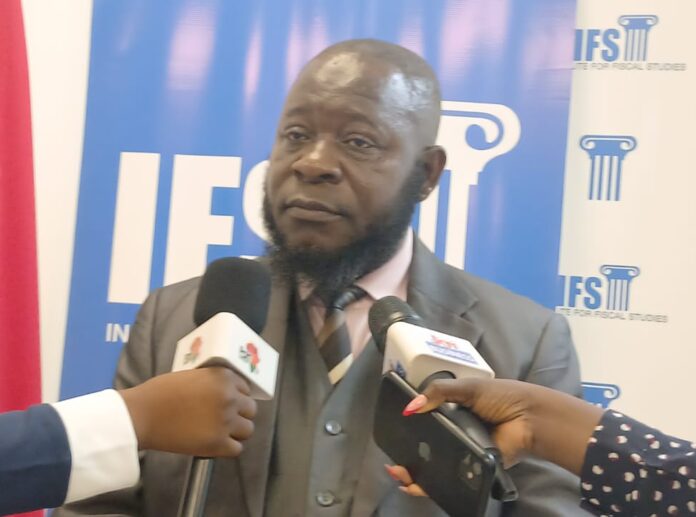

Ghana is losing billions of dollars in potential government revenue through weak revenue mobilisation, leakages, corruption, and excessive tax exemptions, the Institute for Fiscal Studies (IFS) has warned.
Dr Said Boakye, Senior Fellow at the IFS, observed during a press conference on Thursday, November 5, 2026, where he presented an assessment of the country’s revenue challenges ahead of the Finance Minister’s presentation of the 2026 Budget to Parliament next Thursday.
In a presentation titled “A Re-examination of the Low Government Revenue Mobilisation in Ghana,” Dr Boakye said Ghana’s revenue performance remains significantly below that of several African countries despite its considerable natural resource endowment.
Also read: 220 winners, no World Cup trip? Assafuah demands probe into raffles
He noted that Ghana’s total revenue and grants-to-GDP ratio stood at approximately 15.7 per cent, compared with the Sub-Saharan African average of 20.1 per cent, representing a shortfall of about 22 per cent.
According to him, Ghana collected GH¢224.88 billion in revenue and grants in 2025, and argued that had the country achieved the regional average, it could have raised GH¢288.25 billion, an additional $5.05 billion.
More significantly, matching Botswana’s revenue-to-GDP ratio of 29.5 per cent would have increased Ghana’s revenue to approximately GH¢423.06 billion, generating an additional $15.78 billion.
“Would you need debt for such a situation? The answer probably is no,” Dr Boakye remarked.
He said the persistent revenue shortfall has contributed to inadequate infrastructure investment, excessive borrowing, high debt-servicing costs and relatively low economic development.
Dr Boakye identified three major factors responsible for Ghana’s weak revenue mobilisation: low revenue generation from the extractive sector, revenue leakages arising from tax evasion and corruption, and excessive tax exemptions and investment incentives.
On the mining sector, he disclosed that Ghana generated an average of $5.03 billion in mining value added between 2019 and 2023 but collected only $729.6 million in government revenue, representing approximately 15 per cent.
According to him, Botswana, despite recording a lower average mining value added of $2.81 billion, generated $1.72 billion in government revenue, equivalent to 60.9 per cent.
The disparity was even more significant in 2025, when Ghana’s mining sector recorded approximately $13.4 billion in value added but contributed only $1.6 billion in government revenue.
Dr Boakye said matching Botswana’s average mining revenue collection ratio could have generated approximately $8.16 billion for Ghana, representing an additional $6.56 billion.
He argued that the country must reconsider its approach to extractive-sector revenue generation, including greater government participation through direct investment and strategic partnerships.
He proposed production-sharing agreements as a potentially more effective alternative to the existing concession system.
The IFS Senior Fellow also identified corruption, under-reporting, tax evasion and alleged collusion involving revenue administrators as major sources of revenue losses.
Dr Boakye said successive governments have introduced administrative and technological interventions to address revenue leakages, but institutional weaknesses and corruption continue to undermine collection efforts.
He called for stronger accountability mechanisms and a carrot-and-stick approach under which officials who perform their duties diligently are rewarded, while those found engaging in misconduct face appropriate sanctions.
The third concern was the extensive use of tax exemptions and investment incentives to attract foreign investors.
Dr Boakye cited the Free Zones regime, established under PNDC Law 116 in 1985, and incentives under the Ghana Automotive Development Policy, which provide qualifying businesses with tax holidays, import duty exemptions and other concessions.
He said the Ghana Investment Promotion Centre’s Ghana Incentives Inventory listed as many as 31 income tax, customs and financial incentive packages available to businesses.
While acknowledging that incentives could promote investment and industrial development, he questioned whether their economic benefits justify the revenue being forgone.
He cautioned that growth in GDP does not automatically translate into increased national income for Ghanaians, particularly where foreign-owned businesses enjoy substantial tax concessions and repatriated profits.
He urged government to conduct a comprehensive review of existing exemptions, assessing their contributions to employment creation, domestic investment and national development.
Dr Boakye argued that a stable macroeconomic and political environment would provide a more sustainable basis for attracting foreign investment than excessive tax concessions.
To address the challenges, the IFS called for greater government participation in the extractive sector, a stronger fight against corruption and a comprehensive review of tax exemptions.
Dr Boakye suggested that government could temporarily redirect some resources from traditional public investment programmes towards strategic investments in the extractive sector to generate higher future returns.
He maintained that improving revenue mobilisation is essential to reducing dependence on borrowing, financing infrastructure, improving public-sector compensation and accelerating economic development.
The IFS said Ghana’s revenue challenges go beyond tax rates and the introduction of new levies, requiring structural reforms in mining revenue collection, revenue administration and investment incentives.