

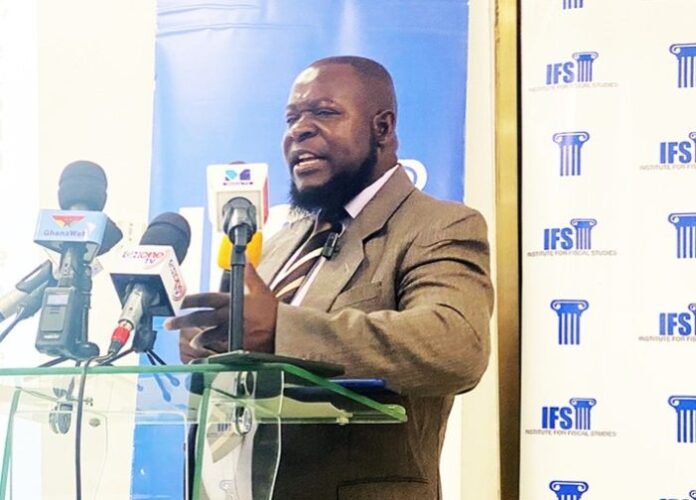

Ghana could have generated an additional US$6.56 billion in revenue from its mining sector in 2025 if it had matched Botswana’s revenue collection performance, the Institute for Fiscal Studies (IFS) has revealed.
According to IFS Senior Fellow Dr Said Boakye, Ghana’s inability to adequately mobilise revenue from its mineral resources is a major contributor to the country’s persistent revenue challenges.
Presenting an analysis of IFS’s policy brief at a press conference on Thursday, November 5, ahead of the Finance Minister’s presentation of the 2027 Budget to Parliament next Thursday, Dr Boakye argued that Ghana collects significantly less from its natural resources than comparable resource-rich African countries.
Also read: ‘You can’t be judge in your own cause’ – Assafuah boycotts Mahama’s World Cup visa probe
He identified weak extractive sector revenue mobilisation, revenue leakages and excessive tax exemptions and incentives as three major factors undermining revenue mobilisation in Ghana.
Dr Boakye disclosed that between 2019 and 2023, Ghana generated an average mining sector value added of US$5.03 billion annually but collected only US$729.6 million in government revenue, representing approximately 15 per cent of the value added.
Botswana, on the other hand, recorded an average mining value added of US$2.81 billion during the same period but mobilised approximately US$1.72 billion in revenue.
This represented 60.9 per cent of its mining value added, compared with Ghana’s 15 per cent.
Despite having a smaller mining sector value added, Botswana generated 135.7 per cent more revenue from mining than Ghana, Dr Boakye said.
He dismissed suggestions that the difference could be explained by Botswana’s diamond industry being more profitable than Ghana’s gold sector.
Citing an IFS publication titled The Role of the Extractive Sector in Ghana’s Comparatively Low Public Sector Revenue Mobilization, published in 2022, he said the economic rent, representing supernormal profits from Ghana’s mining sector, is greater than the entire value of mining output produced in Botswana.
The disparity, he argued, points to weaknesses in how Ghana captures revenue from its mineral wealth.
Dr Boakye said Ghana’s mining sector value added increased to US$13.4 billion in 2025, but government revenue from the sector stood at only US$1.6 billion, representing 11.9 per cent.
Had Ghana matched Botswana’s average mining revenue collection ratio of 60.9 per cent, it would have generated approximately US$8.16 billion instead.
This would have provided an additional US$6.56 billion in revenue.
He explained that the amount represents a substantial portion of Ghana’s estimated US$15.78 billion revenue gap when compared with Botswana’s total revenue and grants-to-GDP ratio of 29.5 per cent.
According to his analysis, matching Botswana’s mining revenue performance alone could have increased Ghana’s revenue-to-GDP ratio from 15.7 per cent to approximately 21.4 per cent, surpassing the Sub-Saharan African average of 20.1 per cent.
The IFS Senior Fellow said Ghana’s overall revenue mobilisation remains significantly below the performance of its African peers.
He cited a total revenue and grants-to-GDP ratio of approximately 15.7 per cent for Ghana, compared with the Sub-Saharan African average of 20.1 per cent.
Using 2025 figures, he estimated that Ghana would have collected GH¢288.25 billion if it had achieved the regional average, instead of the GH¢224.88 billion actually mobilised.
This represented a potential additional US$5.05 billion.
At Botswana’s 29.5 per cent revenue-to-GDP ratio, Ghana could have generated GH¢423.06 billion, equivalent to US$33.69 billion, rather than the US$17.91 billion it actually collected.
Dr Boakye argued that the persistent revenue shortfall has contributed to Ghana’s dependence on borrowing, rising debt-servicing obligations and inadequate funding for development projects.
He also linked weak revenue mobilisation to comparatively poor infrastructure development, lower public sector salaries and subdued domestic demand.
Beyond the mining sector, Dr Boakye identified revenue leakages arising from under-declaration, tax evasion, tax avoidance and alleged collusion involving revenue administrators as another major challenge.
He recalled that the Ghana Revenue Authority’s Commissioner-General, Anthony Sarpong, disclosed in April 2025 that more than GH¢11 billion in potential revenue losses had been uncovered at the country’s ports following the introduction of an artificial intelligence system.
The irregularities reportedly involved incorrect declarations of the country of origin, classification and values of imported goods.
Dr Boakye also cited political corruption as a major contributor to revenue leakages, arguing that Ghana must significantly strengthen accountability and integrity in revenue administration.
He condemned the extensive use of tax exemptions and investment incentives, citing the Free Zones regime established under PNDC Law 116 and the tax incentives introduced under the Ghana Automotive Development Policy.
According to him, the Ghana Investment Promotion Centre’s Ghana Incentives Inventory identifies as many as 31 income tax, customs and financial incentive packages offered to different industries.
He argued that although such incentives are intended to attract investment, their extensive use has undermined the government’s capacity to mobilise sufficient domestic revenue.
The IFS stressed the need for Ghana to strengthen domestic revenue mobilisation, reduce dependence on borrowing, and finance its development priorities as the government prepares to present the 2027 Budget to Parliament on November 12, placing renewed attention on how the Finance Minister can achieve this.