

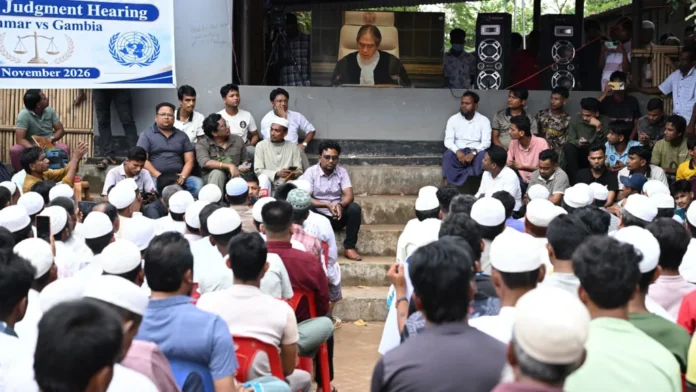

Myanmar has been found guilty of committing genocide against its Rohingya minority by the International Court of Justice (ICJ).
The verdict marks the first time a state has ever been found to have committed genocide by an international court.
Yuji Iwasawa, president of the UN’s top court, said Myanmar had the “intention to destroy” a substantial part of the Rohingya population and engaged in “extensive destruction of evidence” to hide its crimes.
Also read: England fined for fans’ anti-Catholic chants in Spain
A military crackdown in 2017 killed thousands of Rohingya and forced more than 700,000 to flee Buddhist-majority Myanmar, formerly known as Burma. Myanmar denied the claims against it, saying its forces had responded to attacks by armed groups.
The court found on Thursday that “genocidal intent is the only reasonable inference that can be drawn from the evidence” it had seen.
The verdict was reached by a majority of nine votes to six among a panel of judges from around the world. The ICJ also found in favour by majority that Myanmar had violated several other parts of the 1948 Genocide Convention.
The case brought by The Gambia centred around so-called “clearance operations” initiated in 2017 in Rakhine State, where many of the Rohingya Muslim minority resided.
After fighters from the Arakan Rohingya Salvation Army (Arsa) launched deadly attacks on more than 30 police posts there, Myanmar troops, backed by local Buddhist mobs, launched a wave of violence, prompting a mass exodus of Rohingya.
Refugees recounted entire villages being burned down and the mass killing of civilians, while numerous survivors and eyewitnesses provided testimony that the Myanmar military had also raped and abused Rohingya women and girls.
The ICJ determined that around 10,000 Rohingya were “violently killed” during the clearance operation, while more than 700,000 are thought to have fled to Bangladesh by foot or by sea. The court found that approximately 815,000 had been targeted in some way.
Also read: England fined for fans’ anti-Catholic chants in Spain
Iwasawa said Myanmar’s military engaged in “indiscriminate” killings, the execution of men, “widespread” sexual violence, “extreme violence” against children and the deliberate burning of Rohingya homes.
He said the military had also attacked Rohingya as they were fleeing to Bangladesh.
Myanmar, he added, had engaged in “extensive destruction of evidence” by burning or disposing of bodies, burning and bulldozing sites that were cleared, and failed to prosecute those who had perpetrated the acts of violence.
While the ICJ recognised the role Arsa played, it found there was “overlap” between an “anti-Rohingya hate speech campaign” – which portrayed the Rohingya as “sub-human” and “a violent threat” – and the clearance operations that made violence against the population more likely.
BBC