

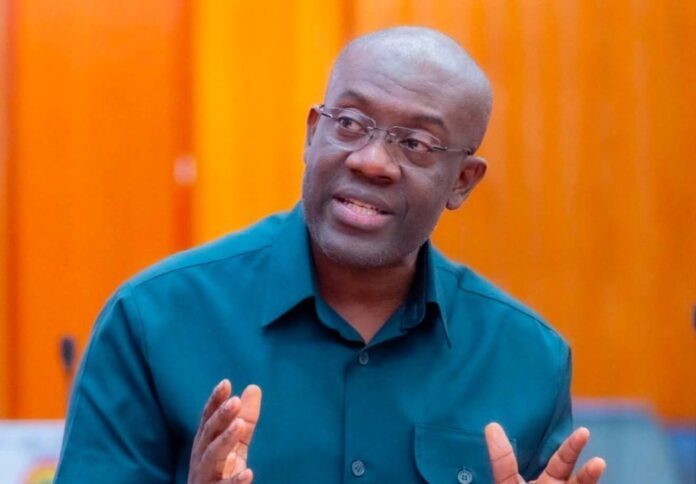

Member of Parliament for Ofoase-Ayirebi and Ranking Member of Parliament’s Economy and Development Committee, Kojo Oppong Nkrumah, has challenged the government to account for the performance of its existing economic programmes before introducing the proposed “New Economy”.
According to the former Information Minister, the government must provide Ghanaians with clear and verifiable evidence of what its flagship initiatives have achieved before committing additional public resources to a new economic framework.
His comments come as Finance Minister Dr Cassiel Ato Forson engages industry, the banking sector and other stakeholders on the government’s proposed New Economy, details of which are expected to be presented in the 2027 Budget.
Also read: Ameyaw-Akumfi mounts defence in SkyTrain case: ‘US$2m investment lawful’
The initiative is expected to focus on increasing domestic production, creating jobs and reducing Ghana’s reliance on imported goods.
Mr Oppong Nkrumah said he supports those objectives but argued that many of the programmes introduced by the government after assuming office had yet to demonstrate measurable results. “The promises made in 2024 have not expired, and the government should be held to every one of them,” he said.
Mr Oppong Nkrumah questioned the performance of the government’s 24-Hour Economy, which was presented as a major component of the NDC’s economic programme and is expected to create 1.7 million decent jobs by the end of 2028.
He noted that GH¢110 million was allocated directly to the programme in the 2026 Budget.
According to him, when he sought information on the programme’s performance in July, the Secretariat cited 268 filling stations and 33 manufacturing companies operating in shifts. The Secretariat also reported 160,000 jobs associated with recently signed agreements.
Mr Oppong Nkrumah disputed the adequacy of those figures and called for independently verifiable information, including evidence of workers employed and Social Security and National Insurance Trust contributions associated with the claimed jobs.
Such information, he said, is necessary to establish whether the jobs being announced represented actual employment opportunities.
The MP also raised concerns about the Women’s Development Bank, another major programme announced by the government. He said the bank is yet to begin lending despite government allocations and preparations to capitalise the institution.
According to him, the government allocated GH¢51.3 million to the initiative in 2025, while the Finance Minister told Parliament in July that GH¢400 million had been deposited at the Bank of Ghana as capital.
Mr Oppong Nkrumah noted that the company was incorporated in January 2026 and is still awaiting a banking licence. He called for a clear timeline for the commencement of lending and greater transparency on the institution’s lending criteria.
The MP also questioned the progress of the One Million Coders Programme, which aims to train one million young Ghanaians over four years.
He said the government has reported 140,000 registrations, 40,000 enrolments and about 28,000 participants completing at least one module by the mid-year review.
Mr Oppong Nkrumah argued that completing a training module was not enough to demonstrate the programme’s economic impact. He called for the government to publish data showing how many participants had secured employment or were earning sustainable incomes as a result of the programme.
The former Information Minister further questioned aspects of the Feed Ghana programme, particularly the Nkoko Nkitinkiti poultry initiative. The programme was introduced to increase domestic poultry production and reduce Ghana’s dependence on imported chicken.
Mr Oppong Nkrumah cited comments by the Agriculture Minister to Parliament’s Assurances Committee that some beneficiaries had consumed the birds instead of rearing them.
He also referred to concerns raised by the Poultry Farmers Association about the implementation of the first phase.
He challenged government to publish data showing how many beneficiaries remained in poultry production and whether the programme had significantly affected poultry import volumes.
Mr Oppong Nkrumah argued that the proposed New Economy is expected to mobilise about US$10 billion over four years for areas including commercial agriculture, mining value addition, energy and transport infrastructure, and questioned whether some of the proposed interventions were substantially different from initiatives already being implemented under the 24-Hour Economy, Feed Ghana and the Women’s Development Bank.
He urged the government to provide a detailed assessment of existing programmes before introducing another broad economic framework.
He disputed the suggestion that the current administration is solely responsible for Ghana’s recent macroeconomic improvements, stressing that several major measures, including the IMF programme, domestic debt exchange and restructuring agreements with Ghana’s creditors, were initiated under the previous NPP administration.
Mr Oppong Nkrumah urged Parliament to scrutinise the proposed fiscal changes carefully, particularly in view of significant domestic debt maturities expected in 2027 and 2028.
He called on the government to publish verifiable data on job creation, provide a timeline for the Women’s Development Bank to begin lending, assess the One Million Coders Programme and independently evaluate the Nkoko Nkitinkiti initiative.
“Parliament should not agree to weaken the country’s fiscal anchor to fund a programme whose details have not even been published,” he said.
He maintained that before Ghanaians are asked to embrace the New Economy, the government must first account for the promises and programmes it presented to voters in 2024.