

The Majority Caucus in Parliament has defended the government’s record in the fight against narcotics, saying significant investments in the Narcotics Control Commission (NACOC) have strengthened the country’s capacity to detect, investigate and disrupt drug trafficking.
According to the Caucus, reforms introduced under President John Dramani Mahama have transformed NACOC from an institution operating under capacity constraints into a nationwide agency capable of responding to increasingly sophisticated drug-trafficking networks.
The Caucus argued that the drug situation in Ghana is a result of significant institutional challenges inherited by the government, including inadequate personnel, logistics, intelligence capacity and limited operational presence across the country.
Also read: Minority demands full account from EOCO over botched arrest attempt on MP Baffour Awuah
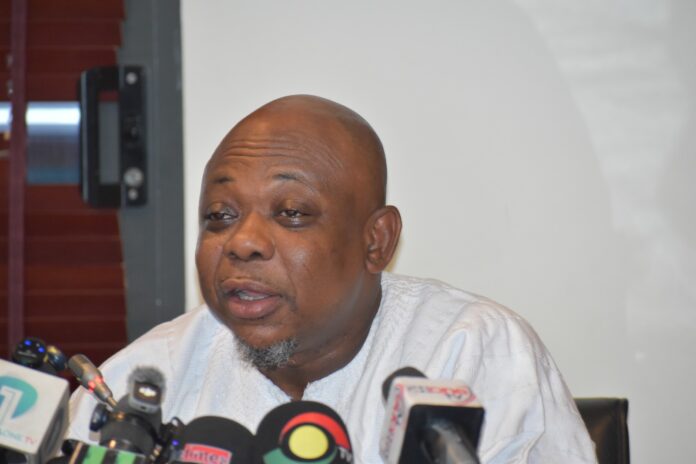
Addressing a press conference in Parliament on Thursday, Majority leader James Agalga stressed that the government had, since 2025, embarked on a comprehensive investment and institutional reform programme to strengthen NACOC.
He pointed to NACOC’s enforcement figures as evidence of increased operational activity, stressing that the Commission recorded 217 arrests in 2025, compared with 73 arrests in 2024, representing a 197 per cent increase.
The Commission also initiated 165 drug-related prosecutions during the period, while enforcement operations resulted in the seizure of narcotic substances and the disruption of suspected trafficking networks. other others.
The Majority leader said the enforcement drive had been supported by increased intelligence-led operations and collaboration among NACOC, the Ghana Police Service, Ghana Immigration Service and other security institutions.
According to him, one of the major changes has been the expansion of NACOC’s operational presence across the country.
Hon Agalga said the number of district commands had increased from fewer than 10 to 77, giving NACOC a presence across all 16 regions.
According to him, the expansion would enable the Commission to move beyond a largely headquarters-centred operation and bring intelligence, enforcement and prevention activities closer to communities.
The Majority leader stressed that investments in intelligence and digital investigations have increased, including the acquisition of modern analytical and digital forensic tools, including i2 Analyst’s Notebook and Cellebrite technology, to strengthen intelligence analysis and digital investigations. A dedicated forensic laboratory, he said, is also under construction.
The Majority leader said the investment is intended to allow investigators to move beyond individual drug seizures and focus on identifying trafficking networks, their financial structures and the proceeds generated from the illicit trade.
The Caucus said the government’s anti-drug strategy was increasingly targeting the financial networks behind narcotics trafficking.
It cited the restraint of 73 suspected tainted assets, the seizure of more than 19 kilogrammes of gold and the restraint of cash and assets valued at more than GH¢6.9 million and US$440,000.
The Majority leader said the approach is designed to weaken the financial incentives that sustain organised drug trafficking rather than focusing exclusively on couriers and individual suspects.
James Agalga, however, acknowledged that significant work remains to be done on drug trafficking, particularly at Ghana’s ports and other entry points.
He stated that effective narcotics control requires a complete chain involving profiling, screening, intelligence sharing, inspection, investigation and prosecution.
He called for stronger participation by NACOC in relevant joint inspections, better integration with the Integrated Customs Management System (ICUMS), real-time access to customs and cargo information, and a fully operational security check desk.
He stressed that the fight against narcotics could not be handled by one institution alone and called on NACOC, the Ghana Police Service, Ghana Immigration Service, Ghana Ports and Harbours Authority and other relevant agencies to strengthen cooperation and intelligence sharing.
According to him, profiling and screening at entry points, investigation, prosecution and asset recovery must operate as parts of one coordinated national system.
The Caucus said stronger cooperation would be critical to disrupting and dismantling organised trafficking networks operating across Ghana and beyond.
While defending the government’s record, the Majority acknowledged that NACOC still faces challenges in technology, infrastructure and specialised resources to be more effective in the fight against illicit drug trafficking.