

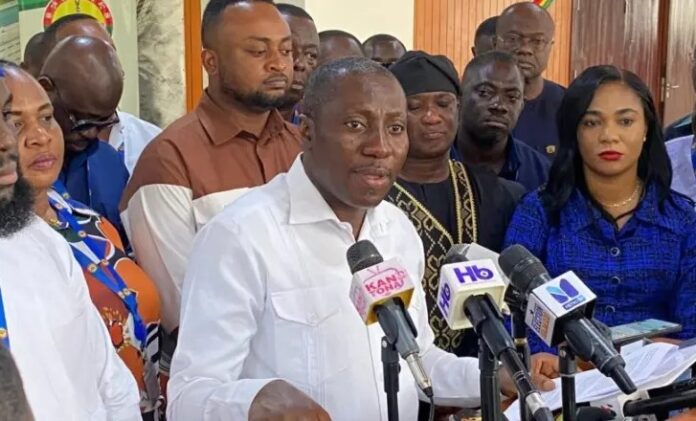

The Minority in Parliament has raised serious due process concerns over the conviction of New Patriotic Party (NPP) Ashanti Regional Chairman, Bernard Antwi-Boasiako, popularly known as Chairman Wontumi.
In a 10-page statement issued on Monday, July 20, the Minority Caucus said it was responding to the High Court judgment delivered by Justice Audrey Kocuvie-Tay, which convicted Chairman Wontumi and Akonta Mining Limited on two counts each under the Minerals and Mining Act, 2006.
The Minority stressed that its position should not be interpreted as a defence of illegal mining, describing galamsey as a “scourge” that has degraded Ghana’s rivers, polluted water bodies and threatened the livelihoods of future generations.
Also read: gov’t to introduce coding, AI and TVET in revised Basic Education Curriculum
“Our concern is institutional. It is with the manner in which state power is exercised, and with whether that exercise is even-handed,” the statement signed by Minority Leader Alexander Afenyo-Markin said.
The Minority’s main objection to the Chairman Wontumi conviction centres on the delivery of the judgment in the absence of his lead counsel.
According to the Minority Caucus, the lawyer had informed the High Court in advance that he would be outside the jurisdiction due to a prior professional engagement.
The caucus argued that the circumstances raised constitutional questions under Article 19(2)(g) of the 1992 Constitution, which guarantees an accused person’s right to be defended by a lawyer of their choice.
The Minority described the development as a “historic breach” and questioned whether the proceedings met the required standards of a fair trial.
The caucus drew parallels between the case and the 2003 conviction of former National Democratic Congress (NDC) official Tsatsu Tsikata, whose conviction was later overturned on appeal in 2016.
“Constitutional rights are not partisan property,” the statement said.
“If that was a miscarriage of justice in 2016, the same standard cannot simply evaporate in 2026 because the accused now wears a different party’s colours,” it added.
The Minority also criticised the High Court’s refusal to refer certain constitutional questions to the Supreme Court under Article 130 of the Constitution.
The caucus cited a 2016 Supreme Court ruling involving the Zanetor Rawlings case as a precedent that, in its view, should have informed the court’s consideration of the application.
The Minority argued that constitutional interpretation should be approached consistently, regardless of the political affiliation of the individuals involved in a case.
The parliamentary caucus further accused the government of applying selective justice in the prosecution of illegal mining cases.
It referred to a July 2025 directive by the Attorney-General ordering investigations into two NDC officials over allegations linked to illegal mining.
According to the Minority, there has been “no comparable update on charges, arraignment or trial dates” in those cases.
The caucus also referred to reports concerning an alleged takeover of a mining concession in Prestea Huni Valley and the prosecution of an NPP Member of Parliament in Asutifi North.
It argued that these cases raised questions about what it described as a “very different tempo and character of state action depending on whose conduct is under scrutiny.”
The Minority Caucus called on the Attorney-General to publish the state’s enforcement record on illegal mining cases involving individuals across the political divide.
It also urged the Court of Appeal to give “full and rigorous consideration” to any appeal arising from the case, particularly where concerns about fair trial rights and due process are raised.
The Minority reiterated that it supports efforts to combat illegal mining and protect Ghana’s natural resources but insisted that enforcement must be guided by constitutional safeguards and equal application of the law.
“Due process is not a technicality to be waived when it is politically inconvenient to enforce it. It is the whole point of having a Constitution at all,” the statement said.