

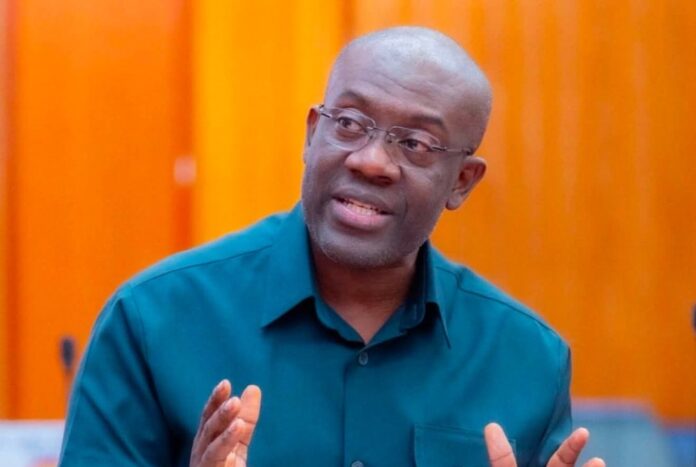

Ranking Member of Parliament’s Economy and Development Committee and Member of Parliament for Ofoase Ayirebi, Kojo Oppong Nkrumah, has stressed that the country’s debt-to-GDP ratio alone does not provide a complete picture of the nation’s debt position.
According to the former Minister of Information, although the reduction in Ghana’s debt-to-GDP ratio from about 61% to approximately 44% is positive, the analysis must take into account other factors that contributed to the improvement.
Seconding a motion for Parliament to adopt the Report of the Committee on Economy and Development on the Annual Public Debt Report for the 2025 financial year on Wednesday, the Ranking Member called for a broader approach to assessing Ghana’s debt sustainability.
Also read: Paul Afoko speaks on Akufo-Addo relationship: ‘I don’t harbour things’
The report, he said, attributed the reduction primarily to the appreciation of the Ghana cedi in 2025 but argued that significant debt restructuring achieved under the previous New Patriotic Party (NPP) administration also played a major role.
“It does not account for the fact that the NPP government negotiated about $5 billion of debt cancellation and another about $4 billion savings in cash flows on our debt stock,” Kojo Oppong Nkrumah told Parliament.
He argued that these gains represented a significant part of Ghana’s debt restructuring programme and urged that credit be given for the contribution of the restructuring exercise to the country’s improved debt indicators.
The Ofoase Ayirebi MP said Ghana’s current Debt Sustainability Analysis (DSA) framework is inadequate because it places too much emphasis on the debt-to-GDP ratio.
He stressed that the country’s ability to repay its debt should be assessed against the resources actually available for debt servicing.
“Nobody pays their debt to their GDP,” he said.
According to him, greater attention should instead be paid to Ghana’s revenue-to-debt-servicing ratio.
He proposed that, particularly for external debt, the country should examine export earnings in relation to external debt-servicing obligations.
The MP said debt servicing could also be assessed against tax revenue to provide a more realistic picture of Ghana’s capacity to meet its debt obligations.
He therefore called for reforms to the country’s debt sustainability analysis framework to ensure that future debt reports provide a more comprehensive assessment of Ghana’s fiscal position.
Definition of Ghana’s debt
Kojo Oppong Nkrumah also raised concerns about the scope of Ghana’s debt analysis, and argued that contingent liabilities, liabilities of state-owned enterprises, and government guarantees are not adequately captured in the debt analysis, potentially resulting in an incomplete picture of the country’s overall financial obligations.
“It gives us a very narrow view of what our debt picture is. And we always get surprised at the end of the day,” he warned.
He recommended a broader debt sustainability analysis that captures a wider range of financial obligations and potential liabilities.
Such an approach, he said, would help policymakers and the public better understand the true risks associated with Ghana’s debt position.
Reliance on cedi appreciation
The Ofoase Ayirebi MP also cautioned against relying heavily on cedi appreciation as an indicator of improved debt sustainability.
He explained that the sharp appreciation of the cedi in 2025 had contributed significantly to the reduction in the country’s debt-to-GDP ratio.
However, he warned that currency depreciation could quickly reverse those gains.
Kojo Oppong Nkrumah said recent debt figures published by the Bank of Ghana following the cedi’s depreciation showed how vulnerable Ghana’s debt position could be to exchange-rate movements.
According to him, an approximately 8% year-to-date depreciation of the cedi had contributed to an increase of about GH¢47 billion in the country’s debt stock.
He argued that this demonstrated why Ghana should not rely on currency appreciation as the main basis for concluding that its debt situation had fundamentally improved.
“If you rely on appreciation to applaud yourself that the debt situation has gotten better, small depreciation, Mr Speaker, and we are now having about a GH¢40 billion increase in our debt stock,” he cautioned.
Kojo Oppong Nkrumah also drew attention to the International Monetary Fund’s projections regarding Ghana’s debt-to-GDP ratio.
He said the IMF is projecting that Ghana’s debt-to-GDP ratio could reach approximately 50% by the end of the year.
He urged Parliament and government to continue monitoring the country’s debt position closely and avoid becoming complacent because of temporary improvements in debt indicators.
NPP debt restructuring
The former Information Minister also reiterated the role of the previous NPP administration in Ghana’s debt restructuring programme.
According to him, approximately 98% of the debt within the pool identified for restructuring had already been restructured.
He said the remaining 2% was yet to be fully concluded and urged the government to complete the outstanding restructuring process.
Kojo Oppong Nkrumah argued that completing the process would allow Ghana to realise the full benefits of the debt restructuring programme.
He cautioned that failure to complete the process could undermine efforts to accurately assess the country’s overall debt position.
He emphasised the need for Ghana to strengthen domestic resource mobilisation, stressing that the most important long-term solution is to improve the country’s ability to generate sufficient domestic revenue to finance development and meet debt obligations.
According to him, effective domestic resource mobilisation would reduce the country’s dependence on borrowing and help prevent the accumulation of unsustainable debt.