

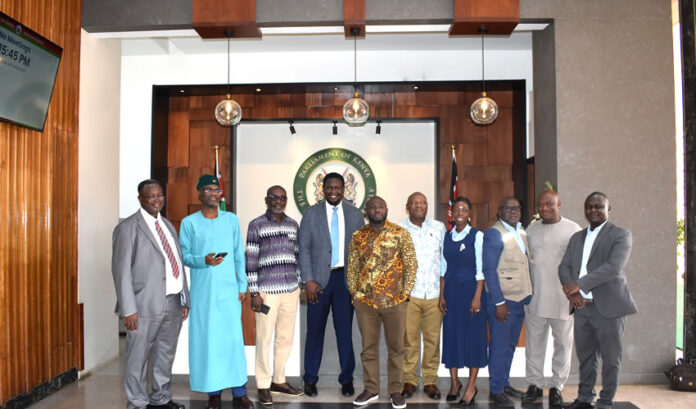

A seven-member delegation from the Parliament of Ghana is in Nairobi, Kenya, on a benchmarking visit to familiarise itself with the parliamentary practices and proceedings of the Kenyan Parliament.
The delegation, led by the Director of Media Relations, Mr Sebastian David Damoah, comprises the Dean, Secretary, Treasurer and a member of the Parliamentary Press Corps, alongside staff of the Department of Media Relations.
The team is on a peer-learning mission to study how the Kenyan legislature has modernised its media operations to enhance transparency, improve public access and strengthen institutional communication.
Also read: Front Pages: Top newspaper headlines for Saturday, 31st October 2026
The visit comes at a time when Ghana’s Parliament is undertaking reforms to strengthen its media relations, improve the live broadcasting of parliamentary proceedings and deepen public engagement.
In Kenya, the Technical Manager of the Parliamentary Broadcasting Unit (PBU), Mr Stephen Nyakuti, took the delegation through the operations of key departments responsible for facilitating public access to Parliament. These include the Parliamentary Broadcasting Unit, the Directorate of Media Relations and the Department of Information and Communication.
The Kenyan officials briefed the team on the unit’s daily broadcasting schedule, which runs from 10 a.m. to 7 p.m. and covers both plenary and committee sittings.
The delegation was also introduced to the PBU’s content strategy, which focuses on live coverage of parliamentary proceedings, explanatory programmes on Bills and motions, and studio interviews with Members of Parliament to simplify complex legislative business for the public.
The team further received briefings on Kenya’s ambitious broadcasting expansion plans, including the procurement of seven new broadcasting kits by June next year to facilitate simultaneous coverage of seven committees, the transition to a 24-hour parliamentary television channel and the launch of an online radio station.
Beyond its achievements, Kenyan officials were candid about the challenges confronting their Parliament.
The Director of the PBU disclosed that the unit operates with only four staff members, comprising three contract employees and himself as the sole permanent staff member. The unit also relies on interns for additional support, making it difficult to sustain its current broadcasting demands.
The Chief Media Relations Officer, Mr Joe Okongo, also disclosed that the Kenyan Parliament deliberately avoids engaging in social media comment sections because discussions about parliaments globally are largely negative, and responding to every comment could trigger further backlash.
Other challenges highlighted included ageing broadcasting equipment installed as far back as 2012, which is now approximately four generations behind modern 4K standards, as well as the rising cost of archiving parliamentary materials as the institution transitions from tape-based to digital archiving.
Mr Okongo further revealed that the Kenyan Parliament is developing five major policy documents to streamline its media operations and strengthen institutional procedures.
These include an accreditation policy, a media and broadcasting policy, a social media policy, a media relations strategy document and a Standard Operating Manual designed to ensure operational continuity and preserve institutional memory.
The benchmarking visit is expected to provide valuable lessons for Ghana’s Parliament as it seeks to operationalise its parliamentary broadcasting system, manage media accreditation more professionally, develop guidelines for social media engagement and establish a robust archiving system.
The Ghanaian delegation is expected to return with recommendations to inform ongoing reforms aimed at making Parliament more open, accessible and responsive to citizens, while leveraging broadcasting and digital platforms to demystify parliamentary work.