

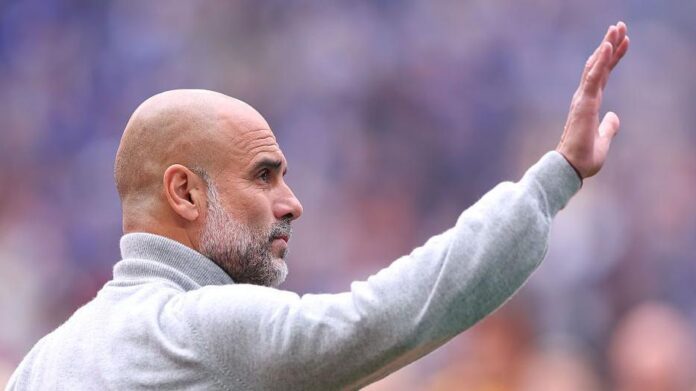

Manchester City manager Pep Guardiola is set to leave the club at the end of the season, bringing to a close one of the most successful managerial eras in English football history.
According to media reports, Guardiola will leave City after a decade in charge, with former Chelsea manager Enzo Maresca expected to replace him at the Etihad Stadium. The 55-year-old is expected to announce his departure shortly after City’s final match of the season against Aston Villa at the Etihad, ending a spell that has transformed City from an ambitious elite club into one of world football’s most dominant institutions.
Guardiola joined Manchester City in 2016 and built a team defined by control, positional play, tactical discipline, and relentless domestic dominance. During his time in Manchester, he has guided the club to multiple Premier League titles, domestic cups, and the club’s first UEFA Champions League crown.
Also read: Damang Gold Mine delivers second 121 kilogrammes full gold output to GoldBod
Saturday’s FA Cup victory over Chelsea gave Guardiola his 20th trophy with City, adding to a season in which the club had already secured the League Cup.
His expected departure is made more striking by the fact that his current contract runs until June 2027, meaning the decision would bring his tenure to an end earlier than the formal expiry of his deal.
Guardiola had publicly played down questions over his future after the FA Cup final. Asked about the rumours by TNT Sports, he responded, “What rumours?” before ending the interview with: “Have a lovely evening.”
Behind the scenes, however, succession planning appears to have intensified, with Maresca emerging as the leading candidate to take over.
The Italian previously worked within City’s football structure, including as part of Guardiola’s coaching environment, and is regarded as one of the coaches most closely aligned with the Spaniard’s tactical principles.
Maresca’s expected appointment would signal City’s desire for continuity rather than rupture. His football philosophy is rooted in possession, high technical control, structured build-up and positional rotations core elements of the Guardiola model that have shaped City’s identity over the past decade.
For City, the choice of successor will be one of the most important decisions in the club’s modern history.
Replacing Guardiola is not merely about appointing another elite coach. It is about preserving a football ecosystem built around specific recruitment profiles, training methods, tactical language and institutional standards.
Guardiola’s impact at City has gone far beyond trophies. He changed the tactical expectations of English football. Under him, the Premier League fully entered the age of inverted full-backs, ball-playing goalkeepers, centre-backs as first-phase playmakers and midfielders operating through carefully structured positional zones.
His 2017/18 City side became the first team in Premier League history to reach 100 points in a single season. City also became the first club in English top-flight history to win four consecutive league titles, a feat that cemented Guardiola’s side as one of the defining teams of the modern era.
The Spaniard’s influence spread across the English game, shaping how rivals pressed, built from the back, recruited midfielders and structured academies. Many teams that once played more direct football gradually adopted elements of Guardiola’s positional model, even if few could replicate it with the same precision.
But his departure also comes at a delicate moment. City remain in the Premier League title race, with matches against AFC Bournemouth and Aston Villa still to come. Arsenal currently lead the table, meaning Guardiola could yet leave Manchester with another league title if City overturn the gap in the final stretch.
The expected transition also coincides with wider changes at the club. Long-serving director of football Txiki Begiristain has already departed and been replaced by Hugo Viana from Sporting CP, signalling a reshaping of the football leadership structure.
There are also indications that senior players could leave this summer, with names such as Bernardo Silva and John Stones linked with possible exits. If those departures materialise, City may face not only a managerial transition but also the beginning of a squad refresh.
He would inherit a club built in Guardiola’s image, but also one entering a new cycle. The challenge will be to preserve the tactical culture while renewing the energy, squad structure and competitive hunger that sustained City’s dominance for a decade.
For supporters, Guardiola’s exit will mark the end of a golden chapter.
He arrived in England as one of football’s great theorists and leaves as one of the Premier League’s great builders. City did not merely win under him; they imposed a standard that forced the rest of English football to respond.
His legacy will be measured in trophies, records, and tactical influence. But it will also be measured in how difficult he is to replace.
Manchester City may have planned for succession. They may have identified a coach who understands the system. But replacing Guardiola is not like replacing a manager at the end of a cycle.