
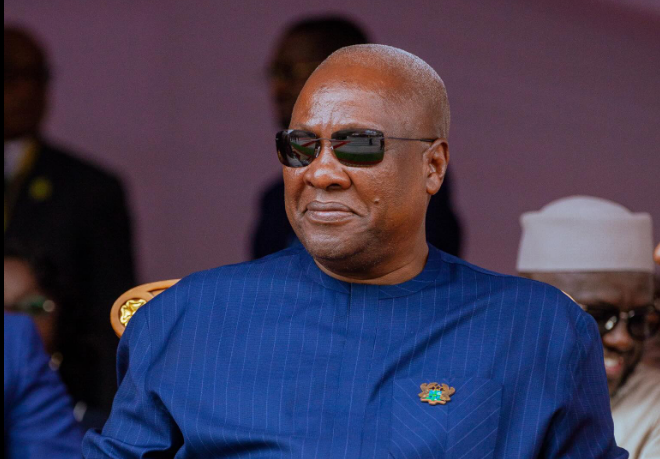

President John Dramani Mahama’s approval rating has declined by more than nine percentage points over the past five months, but a majority of Ghanaians continue to express confidence in his leadership, particularly his management of the economy.
A new nationwide survey released by the Institute of Economic Affairs (IEA) on Wednesday, June 10, 2026, shows that 58.9 percent of respondents approve of the President’s performance in office.
The figure represents a decline from the 68 percent approval rating recorded in the IEA’s previous survey conducted in December 2025 and published in February 2026.
Also read: Minority demands Foreign Minister’s briefing on South Africa evacuation, xenophobic attacks
Despite the drop, the survey indicates that President Mahama maintains a significant lead over those dissatisfied with his performance. While 58.9 percent approved of his leadership, 28.4 percent disapproved, with 12.8 percent remaining undecided.
The IEA survey, conducted in May 2026 across all 16 regions and involving more than 1,000 respondents, suggests that many Ghanaians remain optimistic about the direction of the country, even as concerns persist about the impact of economic gains on household livelihoods.
Among respondents who approved of the President’s performance, 73.5 percent cited the government’s handling of the economy as the primary reason for their support.
Road infrastructure emerged as the second most cited reason, accounting for 16 percent of responses, while energy and electricity issues contributed 2.7 percent.
The findings come amid notable improvements in key economic indicators over the past year.
According to the IEA, inflation fell sharply from 23.5 percent in January 2025 to approximately 3.4 percent by April 2026. The Ghana cedi also appreciated by about 26 percent against major foreign currencies during the same period.
Additionally, the Bank of Ghana’s policy rate declined from 27 percent to 14 percent, while average commercial lending rates dropped from around 32 percent to 20 percent.
The country’s debt-to-GDP ratio also improved significantly, falling from 61.8 percent at the end of 2024 to 45.3 percent by the close of 2025. Ghana further received sovereign credit rating upgrades from Fitch, Moody’s, and S&P, reflecting growing confidence in the economy.
While economic management remains the President’s strongest area of support, it is also the leading reason cited by those dissatisfied with his performance.
Among respondents who disapproved of President Mahama’s leadership, 30.9 percent identified economic concerns as their main grievance.
The IEA said the findings point to a gap between improving national economic indicators and the lived experiences of ordinary Ghanaians, many of whom continue to face challenges related to income levels and the cost of living.
Electricity supply was the second most common concern, with 29.9 percent of dissatisfied respondents citing power-related challenges. The survey was conducted shortly after temporary power supply disruptions in May 2026 that affected several parts of the country.
Corruption also remains a major issue, with 19.1 percent of respondents who disapproved of the President’s performance citing concerns about corruption and the need for stronger action.
Despite the decline in overall approval ratings, the IEA concluded that President Mahama continues to enjoy broad public support across the country.
The institute noted that while Ghanaians generally acknowledge the improvements in economic performance, many expect these gains to translate more visibly into better living conditions and improved household welfare.
The survey forms part of the IEA’s regular assessment of presidential job performance and public perceptions of governance in Ghana.