

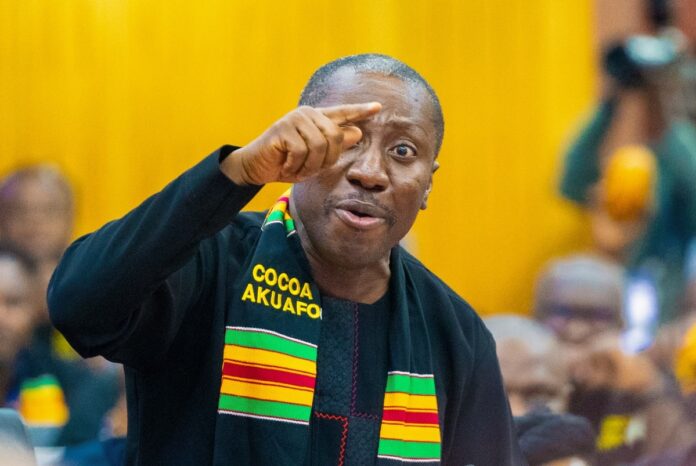

Minority Leader Alexander Afenyo-Markin has touted the policies of former President Nana Addo Dankwa Akufo-Addo as an enduring legacy of deliberate investments in human capital, enterprise, and citizen empowerment.
Flagship interventions such as Free Senior High School (Free SHS), One District One Factory (1D1F), Planting for Food and Jobs (PFJ), Agenda 111, and the Ghana Card, he said, were designed to strengthen productivity and social mobility.
“These policies were not political experiments. They were deliberate investments in the dignity and productivity of the Ghanaian citizen,” he stated.
Also read: Minority launches cocoa ‘price revolt’: Joins farmers to confront government
Speaking at a public lecture on ‘The Danquah-Dombo-Busia centre-right ideology and its impact on Ghana’s socio-economic Development: A focus on the Kufuor and Akufo-Addo Governments, Afenyo-Markin argued that data from the Ghana Education Service indicate more than three million students benefited from Free SHS between 2017 and 2024. The programme eliminated financial barriers that had excluded many children from low-income and rural households.
According to him, the policy ensured opportunity was determined by talent rather than wealth, while additional support such as school feeding improved retention and reduced social challenges, including child labour and teenage pregnancy.
The Akufo-Addo administration, he said, also prioritised technical and vocational education. Under the reforms, 34 new TVET institutions were established, 62 upgraded, and 20 STEM centres constructed nationwide.
“In Winneba, enrolment at the NVTI reportedly rose from 147 students in 2017 to over 3,000 by 2024 following infrastructure improvements.”
“Technical education was restored as a respectable and profitable career path,” he observed, adding that the reforms positioned Ghana for the digital and industrial economy.
The One District One Factory initiative, Afenyo-Markin explained, spread industrial development beyond major cities.
By 2023, about 321 projects were at various stages, with 169 operational and nearly 170,000 jobs created.
“1D1F reflects private-sector-led development supported by the state, not controlled by it,” he said, noting its focus on agro-processing and light manufacturing.
On agriculture, the Minority Leader stressed Planting for Food and Jobs (PFJ) as a major productivity intervention. “Between 2017 and 2019, over two million farmers reportedly benefited from subsidised inputs and extension services.”
“PFJ restored agriculture as a viable business, not a survival strategy,” he said, stressing its role in strengthening food supply chains and improving incomes.
Afenyo-Markin also referred to Agenda 111, which aims to construct district hospitals nationwide to improve access to healthcare.
He argued that the programme reduced travel time for medical services, improved productivity, and enhanced rural investment prospects.
“When healthcare is distant, poverty deepens. Agenda 111 addressed that reality,” he stated.
The national identification system, he said, accelerated under Akufo-Addo and, building on foundations laid during the era of John Agyekum Kufuor, was described as a cornerstone of modern governance.
The Ghana Card now supports banking, NHIS registration, SIM verification, and access to public services.
“Legal identity is the gateway to economic participation,” Afenyo-Markin noted, adding that it strengthened security and reduced fraud.
Defending social programmes, he argued that education, healthcare, and identity systems are essential for functional markets in developing economies.
“Markets cannot work when citizens are excluded from basic capabilities,” he said.
He maintained that social investment under Akufo-Addo and Kufuor was intended to remove barriers to enterprise rather than replace private initiative.
The lecture contrasted the citizen-focused philosophy of J. B. Danquah with the state-led approach of Kwame Nkrumah.
While acknowledging Nkrumah’s historic contributions, Afenyo-Markin argued that excessive state control weakened incentives and productivity.
“Development is strongest when the citizen, not the state, is the main driver,” he said.
Afenyo-Markin maintained that the Akufo-Addo administration strengthened institutions, expanded opportunity, and reinforced Ghana’s centre-right tradition of enterprise and citizen empowerment.
“Empowerment through production is lasting. A nation cannot give what it does not produce,” he said.
He added that Free SHS, TVET, 1D1F, PFJ, and the Ghana Card together form the backbone of a modern, inclusive, property-owning democracy.