
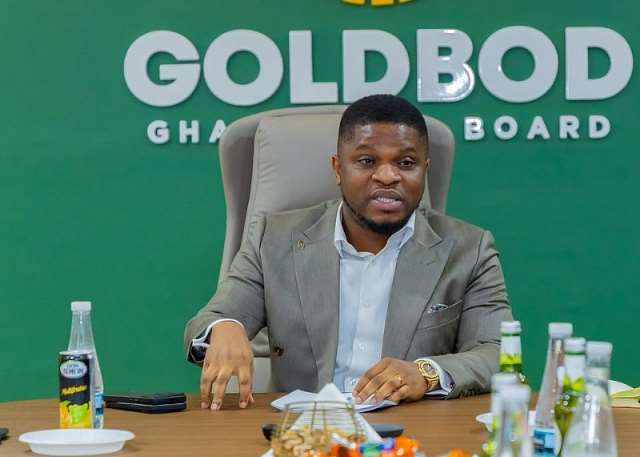

The Ghana Gold Board (GoldBod) has announced a spectacular financial turnaround, posting a massive GH¢5.45 billion surplus for the 2025 fiscal year in a monumental leap for Ghana’s mineral sector.
This stellar performance, fueled by robust revenue growth and a laser focus on operational efficiency, marks a new dawn for the institution.
According to the Board’s latest financial statement, GoldBod generated an impressive GH¢5.56 billion in total revenue, while keeping expenditures at a lean GH¢109.38 million. This result is a dramatic upgrade from the GH¢185.34 million surplus recorded in 2024, signaling a powerful upward trajectory for the state-owned entity.
Also read: NDC opens nominations for branch elections starting May 2
A significant driver of this year’s success was a strategic GH¢4.54 billion seed capital injection from the government. This vital funding empowered GoldBod to scale up its gold purchasing, trading, and export activities, cementing its role as a cornerstone of the national economy.
The Board also demonstrated its ability to generate wealth beyond subventions, recording GH¢983.96 million in non-tax revenue and GH¢35.34 million in finance income.
The Artisanal and Small-scale Mining (ASM) sector proved to be a goldmine for the Board, with aggregation service charges contributing a whopping GH¢568.34 million. Assay fees also added a healthy GH¢340.43 million to the coffers.
Perhaps most impressive is GoldBod’s ability to do more with less. Despite expanding its footprint, the Board slashed total spending to GH¢109.39 million—down from GH¢129.66 million in 2024.
The financial report highlighted a “remarkable improvement in financial efficiency,” noting that the Board incurred zero finance costs in 2025, compared to GH¢46.04 million the previous year. This suggests a successful strategy in reducing debt-servicing obligations and optimizing cash flow.
GoldBod’s financial health has never looked better. Total assets skyrocketed by a staggering 468%, reaching GH¢9.55 billion. Meanwhile, the institution’s cash reserves jumped from GH¢738.18 million to a massive GH¢8.77 billion.
While the Board maintains a healthy relationship with the Bank of Ghana, owing GH¢3.78 billion under the Domestic Gold Purchase Programme, its long-term legacy debts have dwindled to just GH¢17 million.
“The institution has sufficient resources to continue operating effectively,” the Board of Directors stated, expressing unwavering confidence in GoldBod’s future as a going concern. With such a golden performance, the Board is well-positioned to drive Ghana’s mineral wealth to even greater heights in 2026.