

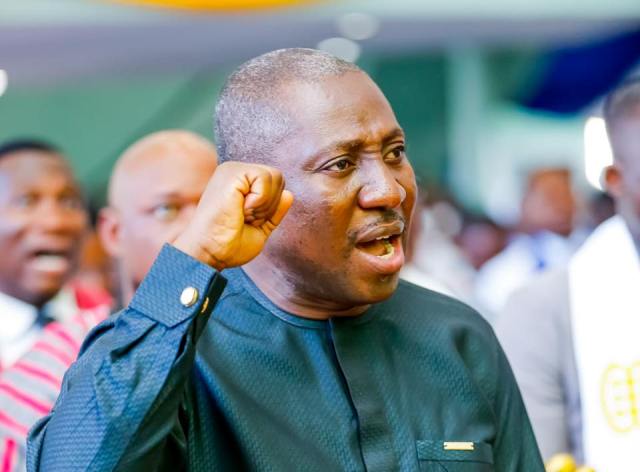

Minority Leader Alexander Afenyo-Markin has accused the government of failing to deliver on its promise to reset governance, claiming that state institutions are being used selectively against political opponents while protecting individuals connected to the governing National Democratic Congress (NDC).
According to him, prosecutorial powers that were previously used to pursue cases involving NDC members and allies under the Nana Akufo-Addo administration have now become less active, while members of the New Patriotic Party (NPP) are being subjected to what he described as politically motivated prosecutions.
According to the Minority Leader, the situation represented a betrayal of the government’s promise of a governance “reset.”
Also read: Comfort Doyoe slams Afenyo-Markin for interrupting discussion on women’s issues
In his closing remarks in Parliament on Friday, July 31, 2026, when the House adjourned sine die, Mr. Afenyo-Markin stated the government’s promise to fight corruption without fear or favour has not been fulfilled.
Mr. Afenyo-Markin cited the acquittal of former Microfinance and Small Loans Centre (MASLOC) Chief Executive Officer, Sedina Tamakloe Attionu, as an example of what he described as unequal treatment under the justice system.
He questioned whether the decision reflected equal application of the law, while criticising the Attorney General’s handling of the case.
He described the government’s “reset” agenda as a “recalibration” of the principles portrayed in George Orwell’s Animal Farm, arguing that the reset appeared to favour one side of the political divide.
The Minority Leader also accused the government of applying double standards in its fight against illegal mining, popularly known as galamsey.
He referred to comments President John Dramani Mahama reportedly made during a meeting with Organised Labour at Jubilee House in March, where the President acknowledged concerns about illegal mining networks and political actors switching allegiance between governments.
Mr. Afenyo-Markin argued that if the President had information about individuals or networks involved in galamsey, the Attorney General should have taken a statement from him as part of investigations.
He contrasted this with the prosecution and conviction of NPP Ashanti Regional Chairman Bernard Antwi Boasiako, popularly known as Chairman Wontumi.
He alleged that the contrasting treatment raised questions about whether the law is being applied equally.
“That is not the rule of law. That is the discriminatory use of the power of the state,” he said, insisting that justice must be applied consistently, regardless of political affiliation.
Speaking on the Tribunals Bill, the Minority Leader called on President Mahama to withhold assent to the controversial bill, warning that it could undermine Ghana’s justice system and revive memories of politically abused tribunals.
According to him, although Articles 125, 142 and 143 of the 1992 Constitution recognize public and regional tribunals, recent constitutional reform recommendations suggest that the tribunal system should be abolished rather than expanded.
He stressed that the Constitutional Review Committee established by President Mahama and chaired by constitutional scholar H. Kwasi Prempeh recommended removing the tribunal system and replacing it with the ordinary courts.
“The President’s own reviewers told him to close this door. Instead, his side in Parliament forced it open,” the Minority Leader stated.
The Minority Leader also demanded full parliamentary investigations into the June floods, the military helicopter crash and the deaths of six young women during the Ghana Armed Forces recruitment exercise.
These three tragedies, he said, required accountability and could not be allowed to fade into silence without a proper investigation.
“Silence is not an answer,” Mr Afenyo-Markin told the House, arguing that the government must provide answers to the families of those who lost their lives.
He called for every member of the task force established ahead of the rainy season to be summoned before the appropriate parliamentary committee to account for their actions and decisions before and during the disaster.
“Not a witch-hunt but an answer,” he stressed, insisting that Ghanaians deserved to know what was done to prevent the loss of lives.
The Minority leader assured that his Caucus had stood for the victims of the June disaster, opposed the Tribunal Bill, defended free speech and called for equal treatment under the law.
He accused the government of ‘executive incompetence,’ ‘majority tyranny’ and a judiciary that, in his view, has become too timid or malleable.
The government, he said, has shown particular creativity in protecting family members, friends and political allies from accountability.
“That is not governance. That is self-preservation dressed up as leadership,” he declared.
Afenyo-Markin nevertheless vowed that the Minority would continue to hold the government accountable when Parliament resumes.
“No matter how long it takes, the day of accountability will come,” he said.