


The ECOWAS Commission has warned that the number of internally displaced people in West Africa could reach nearly 32 million by 2050 as the effects of climate change intensify across the region.
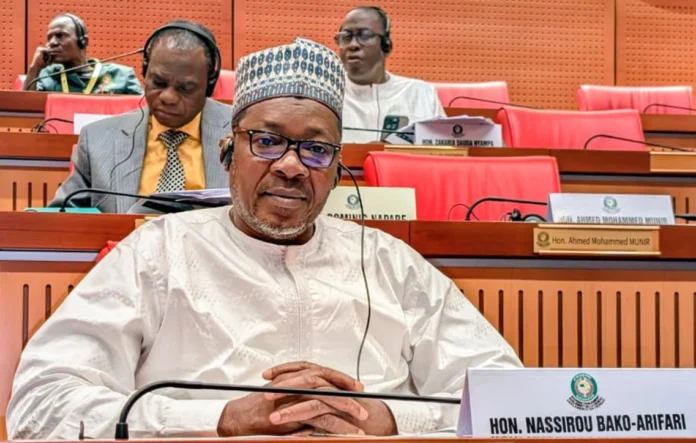
The warning was contained in an address delivered on behalf of the President of the ECOWAS Commission, General Birame Diop, by the Commissioner for Human Development and Social Affairs, Prof. Nassirou Bako-Arifari, at the Second 2026 Joint Parliamentary Seminar in Accra on Tuesday.
The three-day seminar, which opened on September 21 and continues through September 23, is being held under the theme: “Climate Change as a Driver of Environmental Degradation, Population Displacement and Rising Insecurity in the ECOWAS Region.”
Also read: Veep Jane Naana urges ECOWAS to act faster on climate change, displacement and insecurity
Prof. Bako-Arifari said climate change is no longer simply an environmental concern but has become a development, humanitarian, peace and security issue with implications for the survival and stability of communities across West Africa.
He said the region is particularly vulnerable to rising temperatures, changing rainfall patterns, prolonged droughts, desertification, coastal erosion, floods and the degradation of forests and farmlands.
According to figures cited in the address, more than two million people were displaced in 2024 by natural disasters linked to climate change, while more than seven million people were affected by floods.
The consequences, he said, include destroyed homes, damaged roads, health and educational infrastructure, submerged farms, lost food reserves and setbacks to public development programmes.
“Climate change is of this order,” Prof. Bako-Arifari said, describing it as both a systemic risk and a multiplier of human, social, economic and security vulnerabilities.
He disclosed that between 2025 and 2026, the combined effects of climate change and other sources of insecurity and vulnerability has resulted in more than 12 million internally displaced people in West and Central Africa, with women and children accounting for about 80 per cent.
The ECOWAS Commission also expressed solidarity with Ghana following the country’s recent flooding incidents.
Prof. Bako-Arifari extended condolences to the Government and people of Ghana for the victims of the June 2026 floods, which claimed lives and affected thousands of people.
$294bn climate financing gap
The ECOWAS Commission also highlighted the scale of financing required to confront the climate challenge.
According to Prof. Bako-Arifari, the region’s climate-financing needs are estimated at $294 billion, prompting the ECOWAS Commission to initiate work in 2024 towards establishing a regional carbon market platform in line with Article 6 of the Paris Agreement.
The mechanism, he said, is intended to help mobilise investments needed to address the region’s climate-financing requirements.
He noted that the ECOWAS Commission has also taken steps following the adoption of the Paris Agreement in 2015 to support coordinated climate action among member states.
These included the development in 2020 of a practical guide for implementing the Paris Agreement and the adoption in 2022 of the ECOWAS Regional Climate Strategy and its 2022–2030 Action Plan.
The strategy provides a framework for harmonising implementation of the Paris Agreement and the Sustainable Development Goals while promoting common climate action across the region.
Prof. Bako-Arifari said parliamentarians have a critical role in translating regional climate commitments into national action.
Legislators, he said, are responsible for creating appropriate legal frameworks, approving national budgets, exercising oversight and serving as a link between governments and citizens.
Parliamentary action
He proposed five priority areas for parliamentary action.
First, he called for stronger climate-responsive legislation and oversight covering environmental protection, climate adaptation, disaster-risk reduction and sustainable management of natural resources.
Second, he urged governments and regional institutions to prioritise climate financing through predictable domestic and regional resources while improving access to international climate funds.
Third, he called for stronger early-warning and early-action systems, arguing that ECOWAS should shift from reacting to disasters to anticipating and preventing them.
He said regional early-warning systems should be connected to community-level preparedness and rapid-response mechanisms.
Fourth, he advocated inclusive management of land, water, forests and fisheries, with local communities, women, young people and traditional authorities given meaningful roles in decision-making.
Fifth, he urged policymakers to place young people and women at the centre of climate-resilience efforts.
According to him, these should not be viewed only as victims of climate change but also as innovators, entrepreneurs, community leaders and agents of resilience.
New regional security approach
The ECOWAS Commission also called for a broader understanding of security in West Africa.
Prof. Bako-Arifari said security should no longer be defined only by border protection and the prevention of armed conflict but should also encompass access to food, water, livelihoods, a safe environment and opportunities for a dignified life.
He called for what he described as a “new regional compact” focused on climate resilience and human security.
He urged ECOWAS member states to invest in resilience before crises occur, protect ecosystems from irreversible degradation, create livelihoods to reduce pressures that contribute to displacement and address grievances before they develop into conflicts.
He also called for stronger cooperation among ECOWAS member states in climate adaptation, disaster management, food and water security, environmental protection, cross-border resource management and the peaceful management of climate-related migration.
Prof. Bako-Arifari said the Accra seminar should go beyond discussions and produce concrete recommendations, stronger legislation, effective oversight and deeper regional cooperation.
He said ECOWAS should work towards a region where climate resilience is integrated into development planning, displacement is managed with dignity and natural resources become instruments of cooperation rather than sources of conflict.
He called for greater opportunities for young people so that their futures would not be defined by environmental vulnerability and insecurity.
The ECOWAS Commission, he assured participants, would work with the Parliament to implement recommendations emerging from the seminar.
The seminar forms part of the Second Parliamentary Seminar and Second Extraordinary Session of the ECOWAS Parliament being held in Accra from September 21 to 27, 2026.
The extraordinary session is also expected to consider key institutional matters, including the ECOWAS Parliament’s proposed 2027 budget.