

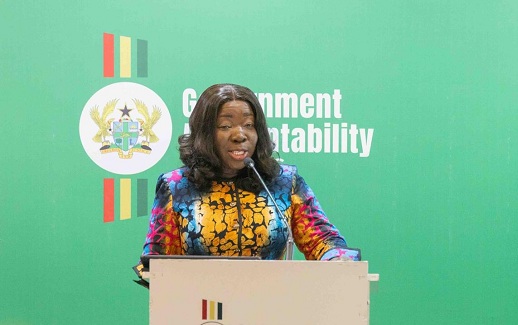

The government is seeking to convert nearly US$12 billion in pipeline investments into operational businesses, increased production, and sustainable jobs as part of efforts to accelerate Ghana’s economic and industrial transformation.
Minister for Trade, Agribusiness and Industry Elizabeth Ofosu-Adjare said Ghana’s investment strategy must move beyond attracting capital and focus on ensuring that investments deliver measurable benefits to the economy.
“Are they expanding our productive capacity, creating opportunities for Ghanaian enterprises, strengthening value chains and opening new markets for what we produce?” she asked.
Also read: Parliament reconvenes today as Bagbin recalls MPs for urgent business
The Minister was speaking at the launch of the 2025 Annual Investment Report, jointly produced by the Ghana Investment Promotion Authority (GIPC), the Bank of Ghana, the Petroleum Commission and the Ghana Free Zones Authority.
Ghana recorded approximately US$2.6 billion in foreign direct investment (FDI) in 2025, covering more than 250 new projects and existing businesses.
The figure also reflected significant reinvestment by companies already operating in Ghana, which the Minister said demonstrated continued investor confidence in the country’s economic prospects.
However, Ofosu-Adjare stressed that the government’s priority was to translate that confidence into stronger businesses, deeper local value chains, expanded production and sustainable economic growth.
She said investments should contribute directly to Ghana’s industrial transformation by strengthening local enterprises and expanding the country’s productive capacity.
The Minister identified agribusiness as a major sector where investment could generate broader economic benefits, particularly through increased local processing of agricultural products.
According to her, processing more agricultural produce locally would enable Ghana to retain greater value within the economy while creating opportunities in packaging, transportation, warehousing, distribution and exports.
Beyond agriculture, the government is prioritising strategic sectors including textiles and garments, pharmaceuticals, automotive manufacturing and components, and agro-processing.
These sectors, she said, are critical to strengthening Ghana’s industrial base, creating productive employment and improving the country’s competitiveness.
Ofosu-Adjare said attracting long-term investment would require a business environment supported by reliable infrastructure, access to finance, skilled labour, regulatory certainty and responsive public institutions.
She noted that proposed reforms, including the Ghana Investment Promotion Authority Bill and the Business Regulatory Reform Bill, are expected to improve investment facilitation and create a more predictable environment for businesses.
The reforms are intended to make it easier for investors to establish and expand businesses while strengthening the institutions responsible for facilitating investment.
On regional trade, the Minister said Ghana’s ability to benefit from the African Continental Free Trade Area (AfCFTA) would depend on the capacity of local businesses to produce efficiently, meet international quality standards and supply markets across Africa.
She said Ghana must therefore ensure that investments generate products and services capable of competing successfully in regional and international markets.
Ofosu-Adjare maintained that the ultimate measure of investment success should not simply be the amount of capital attracted into the country but the economic footprint created by those investments.
“Investment should leave a visible economic footprint in Ghana through expanded production, stronger local enterprises, productive jobs and greater access to regional and international markets,” she said.
The government’s focus, therefore, is increasingly shifting towards ensuring that announced investments move from commitments and pipelines into actual businesses, expanded production, stronger local value chains and jobs for Ghanaians.
CNR