

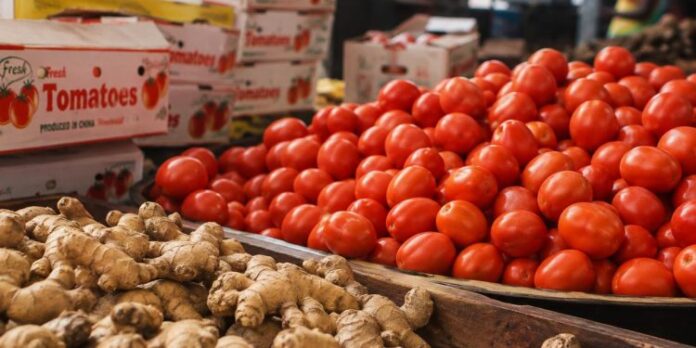

Fresh tomatoes, rent payments and ginger were the biggest contributors to Ghana’s 5.2% inflation rate in September 2026, highlighting the uneven price pressures facing households despite the sharp decline in inflation over the past year.
According to the data from the Ghana Statistical Service, fresh tomatoes alone accounted for 20.3% of the September inflation rate, followed by rent payments at 13.9% and ginger at 9.9%.
Cooked rice contributed 7%, while bus and trotro fares and yam each contributed 5.4%.
Also read: Ghana to cut $500m rice import bill with $18.8m REWARD project
Presenting the detailed inflation figures, the Government Statistician, Dr. Alhassan Iddrisu, said the headline rate masks significant differences in price movements across individual items.
“We are talking about one national rate of 5.2% at the end of September 2026, which contains very different experiences in the market.”
Fresh tomatoes recorded the highest inflation rate among the items tracked in September, with prices rising by 153.4% compared with September 2025.
The Government Statistician explained that this means tomatoes cost roughly two and a half times what they did a year earlier.
Ginger followed with inflation of 100.4%, meaning its price approximately doubled over the same period.
Other items recording some of the highest inflation rates were shrimps at 62.8%, mangoes at 46.6%, and packing space and related services at 40%.
The figures have raised concerns about the impact of fresh food supply on overall inflation, with tomatoes and ginger alone accounting for about 30% of the national inflation rate.
“Also, pay attention to fresh food supply, since tomatoes and ginger alone contribute about 30% of inflation.”
Some food items become cheaper
While some food items recorded sharp price increases, others became significantly cheaper compared with a year ago.
Lime recorded the largest price decline, falling by 29.9%, followed by maize at 26.4%, foreign apples at 24.1%, bambaran beans at 21.7% and carrots at 21.5%.
The contrasting movements underscore the wide differences in price experiences across Ghana’s markets.
Services remain a key pressure point
The Government Statistician also identified services as a major area of concern, with services inflation standing at 8.3% in September.
This compares with goods inflation of 4.2%, meaning prices for services are rising at nearly twice the pace of goods.
“Services inflation is at 8.3 percent at the end of September 2026, and they are the last hurdle for us to deal with, rising twice as fast as goods, which recorded inflation of 4.2 percent.”
Housing, rent, restaurants and transport were among the services contributing to the pressure.
The presentation further showed that Ghana’s inflation is largely being driven by domestically produced items.
Local items accounted for about 86% of inflation in September, while imported items contributed the remaining share.
“Inflation is homegrown, with local items driving about 86% of inflation in September 2026.”
The Government Statistician said the trend should guide policy responses, particularly around food supply and domestic costs.
Regional differences remain significant
The national inflation rate also masks substantial differences across regions.
Dr. Alhassan Iddrisu noted that inflation ranged from 9.8% in the Ashanti Region to negative 0.5% in the Western Region.
“But not least, where you live matters, from 9.8% in the Ashanti Region to negative 0.5% inflation in the Western Region.”
He said the figures should therefore be used by policymakers, businesses and households to better understand where cost-of-living pressures are strongest.
For government, the Ghana Statistical Service recommended using the official Consumer Price Index to guide budgets, subsidies and targeted support.
Businesses were also encouraged to use official inflation data when setting prices and negotiating contracts rather than relying on market rumours.
For households, Dr. Alhassan Iddrisu pointed to the moderation in food inflation, which fell to 4% in September from 11% a year earlier, as providing some room for planning and saving.
CNR