

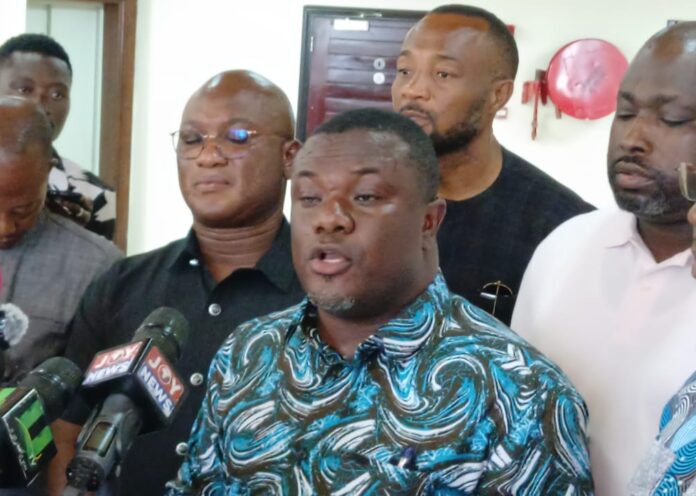

The Minority in Parliament has rejected the government’s claims that recent power outages (dumsor) are linked to the incident at the Akosombo Power Control Centre.
According to the Caucus, the explanation is misleading and politically convenient.
Addressing the press on Tuesday, April 28, 2026, Deputy Ranking Member on Parliament’s Energy Committee, Collins Adomako-Mensah, argued that the ongoing power crisis predates the April 23 incident and reflects systemic failures under the current administration.
“The dumsor crisis was not caused by any incident at Akosombo. It was caused by this government. Dumsor Existed Before Akosombo Incident,” he declared.
Also read: Jerry Ahmed Shaib ‘boots up’ candidates with made-in-Weija sandals for BECE
According to the Deputy Ranking, persistent and unannounced outages had already plagued the country months before the Akosombo disruption.
He pointed to widespread blackouts, emergency maintenance schedules by the Electricity Company (ECG) of Ghana, and public complaints from businesses and households.
“Communities were living in darkness, not for hours but for days. That was the reality before any incident at Akosombo,” he emphasized.
The Caucus also referenced comments by President John Dramani Mahama, who had earlier described the outages as a necessary step rather than dumsor.
“The Ghanaian people did not believe him then. They do not believe him now,” Adomako-Mensah added.
The Afigya Kwabre North MP argued that the government inherited a structured recovery plan—the Energy Sector Recovery Programme (ESRP)—but failed to implement it effectively.
He noted that the programme, developed under former President Nana Addo Dankwa Akufo-Addo and former Vice President Mahamudu Bawumia, was designed to stabilize the sector financially and operationally.
“It was not a wish list. It was a working plan agreed with international partners,” he stressed.
Despite Ghana having installed capacity exceeding peak demand, the Minority insists the crisis is rooted in financial mismanagement, not generation deficits.
The group also criticized the directive by Energy Minister John Abdulai Jinapor asking GRIDCo’s CEO to step aside, alongside changes at the Ghana Grid Company Limited.
“These actions may generate headlines. They will not generate electricity,” Adomako-Mensah said.
He described the move as deflection, arguing that systemic policy failures, not individual officials, are responsible for the crisis.
The Minority also raised a major concern of a lack of transparency surrounding the GH¢1 fuel levy introduced to support the energy sector.
They demanded a full accounting from the Ministries of Energy and Finance, questioning how much has been collected and how the funds have been used.
“No report on this levy has been presented to Parliament. No public accounting has been made,” Hon Adomako-Mensah noted.
He alleged that the government still owes over $500 million to Independent Power Producers (IPPs) and over $200 million to fuel suppliers.
He underscored the real-life consequences of the outages, citing disruptions to businesses, hospitals, and education.
“Every outage… is a factory that has stopped production, a hospital ward running on a generator, a family that has gone to bed in the dark,” Adomako-Mensah said.
The Minority outlined several immediate steps the government must take, including the full implementation of the Energy Sector Recovery Programme (ESRP), the urgent clearance of outstanding debts owed to Independent Power Producers (IPPs), the commissioning and publication of a comprehensive national infrastructure safety audit, a prompt appearance by the Energy Minister before Parliament to brief the House on the state of the sector, and a transparent, evidence-based investigation into the Akosombo incident.
The Minority concluded that the ongoing crisis is the result of prolonged policy failures rather than a single incident.
“Ghanaians are living in darkness because of what this government has done… and failed to do,” Adomako-Mensah asserted.
The Minority, he said, will pursue parliamentary scrutiny and ensure accountability for the energy crisis.