

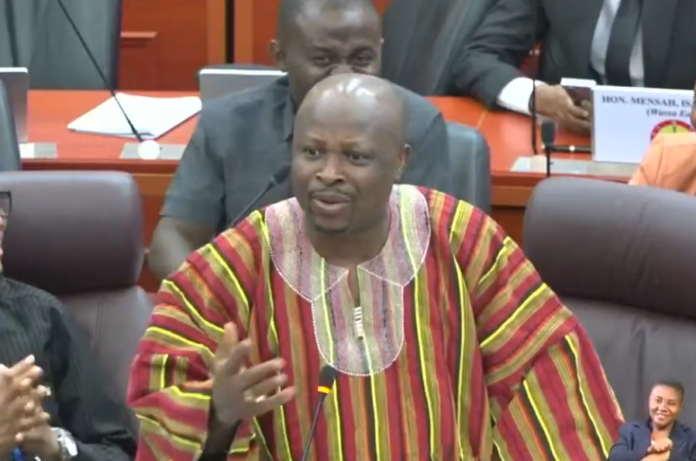

A dramatic exchange in Parliament on Thursday stole the spotlight after Deputy Majority Leader Richard Acheampong repeatedly questioned whether it was wrong to be a witch.
According to him, people choose to be Christians, Muslims, or traditionalists, and question why others cannot be pagans and choose to be witches and wizards.
His questions, however, prompted the Speaker to shut down the debate as the government unveiled fresh measures to combat witchcraft accusations across Ghana.
The unusual intervention came on Thursday while the Minister for Local Government, Chieftaincy and Religious Affairs, Ahmed Ibrahim, responded to a question from Kumawu MP Ernest Yaw Anim on efforts to mobilise chiefs and community leaders to tackle the persistent problem of witchcraft accusations.
Also read: The Front pages: Friday, 26th June, 2026 (Newspapers)
Mr. Acheampong interrupted to ask: “Is it wrong to be a witch? I want to find out from the Minister. Whether it’s wrong to be a witch. Is it wrong to be a witch?”
The Speaker immediately ruled that the question was outside the scope of the matter before the House.
“File a fresh question,” the Speaker directed, explaining that Parliament was considering measures to address witchcraft accusations – not whether witchcraft itself was right or wrong.
Still unconvinced, the Deputy Majority Leader doubled down.
“No, Mr. Speaker, if I’m a witch and you accuse me, I’m a witch. So what is the point?” he argued.
The Speaker again declined to entertain the argument, insisting that Mr. Acheampong submit a separate question if he wished to pursue the matter.
The exchange triggered laughter across the chamber but underscored the complex and sensitive debate surrounding witchcraft accusations, which continue to fuel violence, stigma, and the banishment of alleged victims – particularly women, children, and the elderly.
Responding to the substantive question, Ahmed Ibrahim described witchcraft accusations as one of Ghana’s enduring human rights challenges and outlined a comprehensive strategy to eliminate the practice.
“The phenomenon of witchcraft accusations remains a pressing social challenge in our country, often resulting in stigma, violence, and exclusion of vulnerable groups, especially women, children, and the elderly,” the Minister told Parliament.
He disclosed that although the Private Member’s Bill on Witchcraft Accusations, sponsored by Madina MP Francis-Xavier Sosu, is yet to become law, the government is already laying the groundwork for its implementation through nationwide public education and stakeholder engagement.
According to the Minister, the Ministry will review existing sub-national laws on witchcraft accusations to ensure they comply with international human rights standards, while working closely with chiefs, religious leaders, and traditional authorities to transform public attitudes.
“Chiefs and traditional leaders are custodians of culture and authority in their communities. Their support is critical in reshaping attitudes, preventing harmful practices, and promoting reconciliation,” Ahmed Ibrahim stated.
He announced plans to hold nationwide consultations with chiefs, religious organisations, and community leaders, while incorporating the views of traditional authorities into the review of existing laws and the proposed legislation.
The Ministry will also deepen collaboration with the Ministry of Gender, Children, and Social Protection to provide shelters, psychosocial support, and protection services for victims of witchcraft accusations, domestic violence, child trafficking, and child marriage.
Community-based protection mechanisms involving traditional authorities and faith-based organisations will also be strengthened to prevent violence and support vulnerable persons.
Ahmed Ibrahim expressed confidence that the interventions would encourage chiefs and religious leaders to publicly denounce witchcraft accusations, reduce incidents of violence and discrimination, and improve the reintegration of victims into their communities.
He appealed to Parliament, traditional leaders, faith-based organisations, and civil society groups to unite in ending the practice.
“Let Ghana be known not for exclusion and fear, but for dignity, compassion, and justice for all,” the Minister urged.