


In mid-2020, while Covid lockdowns gripped the country, Luke and his wife decided to start a family.
“All through my teens the message was clear: don’t have sex without a condom or you might get someone pregnant,” he says. “So, when you’re older, you expect everything to just happen normally. When it doesn’t, you don’t know what to do or where to go.”
After 18 months without success, the couple saw their GP and were referred for further tests in hospital and at a fertility clinic.
Over the next year or so, Luke says the focus was entirely on his wife. Appointments were all in her name. When he had to fill out paperwork, his wife was contacted even though all his details were on file.
Also read: King Charles becomes first monarch to reveal tax bill as royal public funding to double to £100m
“At the heart of it, the whole system is based on the assumption that it’s a woman’s problem,” he says. “The male side gets totally overlooked.”
It took more than a year, and a failed round of IVF, until Luke was told there might be an issue with his sperm. “I was like, ‘Now you’re telling me?'” he says. “There were things on my side that could have been looked into much sooner, rather than treating me as an accessory to the process.”
Infertility affects roughly one in six couples and about half of those cases are linked to male problems, either alone or alongside female causes. Under the latest clinical guidelines from NICE (National Institute for Health and Care Excellence), couples still struggling to conceive after 12 months of unprotected sex should be assessed together as one unit, with men and women offered further checks in parallel. Yet experts say men are often sidelined in diagnosis, treatment and in fertility conversations.
“There can be genuine exclusion even if it’s unintentional,” says Prof Bola Grace from University College London. “Men tell us it can happen across services – in how care is delivered, in fertility clinics and in counselling.”
A study led by Grace in 2019 found many men wanted to be more involved in the fertility process, but often felt their voices were not heard. The result, she argues, is often self‑perpetuating – some fertility services don’t include men, so men engage less, which reinforces the idea they are simply not interested. “We’ve created a cycle where men are excluded, but then they’re also blamed for not showing up,” she says.
This can have real consequences, she adds – not just for men but for women, who often end up having to deal with far more of “the coping, the planning, the worrying, the decision-making”.
It can also mean problems are picked up later, tests and treatment can be more invasive, and couples may face a tougher, more expensive path through fertility care. So how could the system offer more support when a man has been told he may have a problem? And what more could be done to get men to talk more openly about fertility?
‘Ignored by the system’
Since the first IVF birth in 1978, fertility treatment has largely been framed around women, partly for biological reasons. IVF involves stimulating the ovaries to produce eggs, retrieving them, fertilising them in a laboratory and then implanting the resulting embryo back into the womb. By contrast, most men provide a sperm sample and wait for science to do its thing.
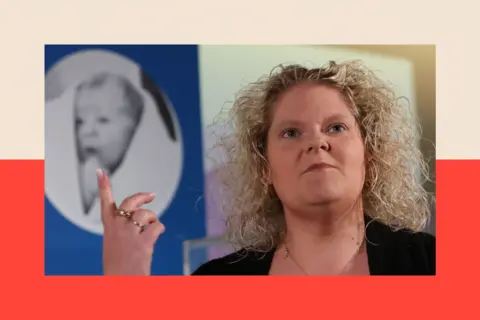
That imbalance has shaped how fertility care has developed, argues Allan Pacey, professor of andrology (a medical specialty focused on male reproductive health) at the University of Manchester. He says fertility units and clinics are typically led by gynaecologists, whose training focuses on female reproductive health, while male fertility can often be treated as a secondary concern.
“Now, there are some really good gynaecologists that do it well, because they’re interested in this, but at the level of the GP or the secondary care clinic or the tertiary care clinic, men can be an afterthought.”
The Department of Health has recently published separate men’s and women’s health strategies, setting out the government’s 10-year vision for healthcare in England. Fertility features around 20 times in the women’s version, with a page devoted to support and clinical guidance. In the men’s document it is mentioned just five times, and mostly in relation to obesity, alcohol or other health issues.
Pacey, also a former chair of the British Fertility Society, calls this a “missed opportunity to level the playing field”.
“This is absolutely not saying that we should do less for women, we should probably do more for women as well,” he says. “But by giving men a proper role, we can fundamentally change what happens in the future, both in terms of their experiences, but also in the terms of what we can do research-wise or treatment-wise.”
A Department of Health and Social Care spokesperson said: “It is right that men receive the same level of support, information and care as women when navigating fertility problems”. It says it will continue to work with NHS England to make sure men’s fertility is “properly reflected in how services are designed and delivered”.
At one point, Luke had an ultrasound scan of his testicles but didn’t hear back for more than a year – until he reminded the clinic about it. A review revealed a varicocele – a swelling of veins in the scrotum that can affect sperm quality. He was treated, but the couple’s fertility problems persisted.
It took another nine months, after paying to see a private andrologist, for Luke to receive any detailed one-to-one advice on lifestyle and diet.
“It’s been a pretty tough, lonely place,” Luke says. “There’s the blow of finding out there’s a male factor involved – which goes against all sorts of stereotypes about masculinity. But then there’s a second level: feeling completely left out and ignored by the system.”
Now, the couple are in the middle of another round of IVF using ICSI, a technique in which a single sperm is injected directly into an egg with an ultra‑fine needle, rather than allowing fertilisation to occur by exposing the egg to thousands of sperm in a laboratory dish.
An ostrich moment
Clinicians say the picture is beginning to shift, but only gradually. “Things are moving in the right direction, but we are still well behind,” says Prof Hussain Alnajjar, a consultant urological surgeon at University College London Hospitals and the Cleveland Clinic London.
For example, it is starting to become more common for a man to see a specialist before his female partner – if an initial semen analysis suggests a potential problem. “That’s what I mean by things are changing but it’s happening slowly,” he adds. “Overall, women are still far more likely to be assessed first when it comes to infertility.”
For men like James, 34, from North Yorkshire, that slow pace of change has shaped their experience.
After James and his wife had difficulty conceiving, he had what he describes as an “ostrich moment”; months of burying his head in the sand while his partner went through all the checks and tests. “Every day, I think about that moment and the time wasted,” he says.
James was away for work on a construction site when the results of his semen analysis eventually came through. He was told his sperm were “weak, slow and malformed” and later found out he would struggle to conceive naturally. The near three-hour drive home that day was “like a blur, very painful”.
There were delays with his diagnosis. It took another two years – and a private consultation with a urologist – before he was given a full physical examination and more advanced hormonal tests. After years of trying, and multiple rounds of IVF, the couple’s fertility treatment was ultimately unsuccessful.
“You’re the partner of someone who you love unconditionally, but you view yourself as the cause of their pain,” he says. “You feel you’re the reason they can’t have a child.”
Male infertility can often be mixed up with ideas of virility and masculinity, making it more difficult for some men to acknowledge or discuss the problem. Prof Pacey recalls hearing about a barbecue where “all the women were at one end talking about IVF, and all the men at the other talking about football”.
James did not see his fertility problems as a challenge to his masculinity, but the stigma surrounding the issue meant he struggled to find support during that time. “It’s just you and your partner dealing with this, so it feels like you’re an island and there’s no-one else out there like you,” he says. “You don’t know where to go, who to turn to, or what to say.”
Under UK law, fertility clinics must offer counselling before treatment, but it need not be free or ongoing. The fertility regulator, the HFEA, says that there are far fewer support groups – either online or in the real world – for men than for women. But there are some signs that may be starting to change.
Shaun Greenaway, 43, was diagnosed in 2018 with azoospermia – a condition in which no sperm are present in the semen. The cause is unclear, although he had severe mumps as a teenager – a virus known to be linked to male infertility.

He and his wife eventually had children through sperm donation, but Shaun says he navigated much of that experience alone. “There was absolutely no support, and no-one was talking about it from a personal perspective, so I decided I was going to share my story,” he says.
Along with a friend, Ciaran Hannington, 40, he co‑founded the Male Fertility Podcast and a support network for men experiencing fertility problems, with WhatsApp groups and in‑person meet‑ups. They compare the conversation around male infertility today to where mental health was a decade or so ago – still taboo but slowly becoming more open.
“There’s such a deep-rooted stigma but, sadly, it’s one of those topics that you don’t really take any notice of until you have to,” says Ciaran, who was also told he had fertility problems in 2012. He says it took two years until he “started to take control” of his situation and make lifestyle changes – improving his diet, cutting out alcohol and adjusting his exercise regime.
After seven rounds of IVF and two miscarriages, his wife, Jennifer, finally gave birth to a boy and a girl.

Studies show that stress, poor sleep, smoking, alcohol and diet can all damage sperm quality. But small, short-term changes are unlikely to have much impact, says Prof Pacey.
“Any lifestyle change needs to be sustained,” he says. “It takes three months to produce sperm from start to finish, so if you stop drinking on a Friday night then don’t expect an improvement by Monday morning.”
Not all men act on that advice.
Shaun says he’s spoken to some women – “never blokes, by the way” – who say their partners have refused to give up cigarettes, alcohol and drugs, despite being told it could affect their chances of having children.
A small study by researchers at the University of Dundee in 2022 found that roughly one in six European fertility specialists said they regularly struggled to persuade men to take a sperm test.
On a global basis, some men were uncomfortable providing a sample, while others assumed they had no fertility problems because they were sexually active or had previously fathered a child.
Signs of a shift
There are indications that awareness is starting to shift.
New PSHE lesson plans for schools in England, developed by the British Fertility Society and Cardiff University, now give male fertility risks – from poor diet to smoking and steroid use – the same prominence as those faced by women.
And at this year’s giant Fertility Show in London’s Olympia, attended by around 2,000 people over two days, organisers said male infertility would be placed centre stage for the first time. Stalls offering high-tech sperm testing kits sat alongside more established services such as egg freezing and pregnancy supplements, while seminars focused on sperm quality and the latest treatment options for men.
“[It’s] not a token addition. Not a side conversation,” said the show’s content director, Sophie Sulehria. “It’s about recognising that male fertility is not a niche topic. It’s a fundamental part of reproductive health. And it deserves the same visibility, the same investment, and the same compassion.”
 Universal Images Group via Getty Images
Doctors working in the field also say they are seeing a shift and that it matters for reasons beyond having a family. Growing evidence suggests male infertility can be a marker of wider health problems from obesity to smoking or hormonal abnormalities, according to Prof Alnajjar, who also speaks for the British Association of Urological Surgeons.
“Healthier men tend to have better reproductive health, and an abnormal sperm test can sometimes be the first sign that further medical assessment is needed,” he says. “That’s why I believe male infertility should not be viewed solely as a pregnancy issue; it should also be recognised as an important men’s health issue and an opportunity for early intervention.”
For men like James, whose lives have been shaped by infertility, progress like this cannot come soon enough. “We’re not going to change the stigma that still exists by burying our heads in the sand and ignoring it anymore, but by getting it out there,” he says.
“As soon as we’re more open, then fewer people are going to think it’s taboo, or that anyone is any less of a man for actually talking about it.”